Backyard Cricket
The backyard of my grandparents' house in suburban Melbourne, Boxing Day afternoon, the Hills Hoist clothesline at silly mid-on, the brick wall behind the wickets, the forty-celcius sun making the lawn brown and crackly. The wickets are a metal rubbish bin upturned. The bat is my dad's old county-cricket willow that's seen better days. "Howzat!" my cousin yells when the tennis ball thwacks the bin and rattles. The kookaburras in the gum tree two doors over laugh in their three-note cackle. The Test match is on the telly inside, but we're not watching it — we're playing our version in the yard.
How it was played
Backyard cricket is a folk-rule, scaled-down version of cricket played wherever Australians (and New Zealanders, and South Asians, and the British, and anyone who has the cricket-bug) have a small available space and a few hours. The space might be an actual suburban backyard. It might be a beach at low tide. It might be a rooftop, a park corner, a quiet suburban cul-de-sac on a Sunday morning.
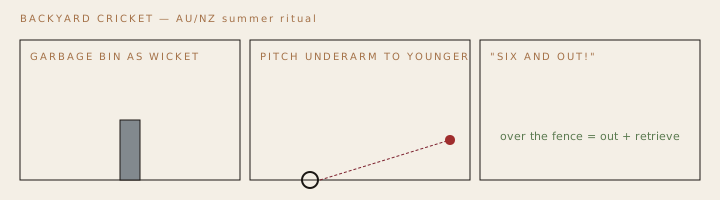
The equipment is whatever is available. A bat — ideally a real cricket bat, but acceptably a chunk of 4×2 timber, a tennis racquet, a cricket-stump itself wielded as a bat in dire circumstances. A ball — almost always a tennis ball (the standard cricket ball is too hard for backyard surfaces and too dangerous for backyard windows), sometimes a "compo" ball wrapped in cloth tape. Wickets — a metal rubbish bin, an upturned milk crate, a stack of beer cans, an old garbage bag stuffed with newspaper, a wooden stake driven into the ground. Boundary — the fence, the back wall, the neighbour's hedge.
The folk-rules. Different in every backyard but with strong continuities:
One-hand-one-bounce: a fielder catches a one-bounce hit with one hand — out. This is the most universally observed backyard rule. It accommodates the small space (where every hit will bounce at least once before reaching a fielder).
Tip and run: any contact with the bat (even a glancing edge) requires the batter to run. There is no playing-and-missing without consequence; if the bat touches the ball at all, the batter must commit to a run.
Last man stands: when only the final batter remains (the number eleven), they bat alone. The fielder bowls; the batter hits and runs back-and-forth between wickets and a chosen point alone, scoring runs by completing each return. This makes the endgame dramatic.
Six and out: hitting the ball over the boundary fence — onto the neighbour's lawn, into the road, over the back wall — scores six but is also out. The rule exists because retrieving a ball from a neighbour's garden requires either climbing the fence or knocking on the door, both of which interrupt play. Six-and-out keeps batters honest; the genuinely huge slogger is constantly fetching their own balls.
Automatic wicketkeeper: when there are too few players, the wall behind the batter (or whatever flat surface stands behind the wickets) is the automatic keeper. A ball that hits the wall on the full from a missed shot counts as a catch — out.
Trees and obstacles: the Hills Hoist is silly mid-on. The garden gnome is a fielder. The dog (sleeping in the shade) is exempt; if the ball hits the dog, the over restarts. The lemon tree branch counts as the boundary on the leg side.
Each player bats and bowls in rotation. There are no umpires; arguments are settled by the loudest voice or by the appeal "Howzat?" with the rest of the players voting in chorus. Disputes are recorded only in the family memory; there is no scorebook.
A typical backyard match runs 20-40 overs total — depending on the size of the yard, the heat, and whether somebody's mum has called for lunch yet. The pace is leisurely. The talk between balls is constant — "Mate, that wasn't out, the keeper's hand wobbled", "Bowl him a googly!", "He's got a Bradman cover-drive comin', watch it". The Test match commentary on the radio (or the kitchen-window TV) provides ambient inspiration.
The setting is the post-Christmas Australian summer. Boxing Day is the canonical backyard cricket day — when the Boxing Day Test (Australia vs. England, India, or whoever else) is being played at the Melbourne Cricket Ground, and every backyard from Perth to Cairns has a parallel match underway in homage. The leftover pavlova is on the picnic table. The cousins are visiting from interstate. The summer has another four weeks before school resumes. The kookaburras are commenting on the proceedings from the gum trees.
Variants. Beach cricket — played on hard wet sand at low tide, with the wickets stuck into the sand and the boundary being either the surf or the dune line. Street cricket — played in suburban cul-de-sacs with chalked wickets on the brick wall and the six-and-out boundary being any garage door or any moving car. Park cricket — played in public parks with goalposts as wickets and joggers as obstacles. Subcontinental street cricket (closely related and sometimes considered a separate game; we'll write IN-street-cricket separately if it makes Phase 2) is the very-similar game played in Indian, Pakistani, and Bangladeshi gullies with broadly the same folk-rules but different specific obstacles.
What it meant
Backyard cricket is the foundational sport of Australian summer. Every Test cricketer in Australian history has played backyard cricket as a child — there is no other path. Steve Waugh, Ricky Ponting, Adam Gilchrist, Allan Border — every great Australian batter has stories of the backyard match where they first learned to drive, hook, pull, and survive.
The Australian cricket commentariat has an explicit theory: the technical idiosyncracies of Australian batting (the lower stance, the strong cut shot, the willingness to play horizontal-bat shots) are partly products of backyard cricket on small spaces. When your boundary is six metres away, you learn to play short shots; when your backyard tennis ball bounces high off concrete, you learn to play balls at chest height. The folk-rule architecture shapes the technique.
It also taught the Australian sporting culture writ small. The egalitarian umpire-by-shouting, the trash-talk vocabulary, the easy mixing of generations (a six-year-old batting against an uncle bowling underarm tennis-ball loops), the absolute primacy of the rule that the kid who owns the bat sets the rules of the game. Backyard cricket is, in microcosm, Australian sporting democracy.
The cousin games are the wider colonial-cricket folk-game family. Subcontinental street cricket in India, Pakistan, Bangladesh — same idea, urban gully space, often with even more elaborate folk-rules. British street cricket in working-class English neighbourhoods of the 1950s-70s. Caribbean beach cricket in Barbados and Jamaica, with the sand-wickets and reef-line boundary. New Zealand backyard cricket, essentially identical to the Australian version with different folk-tree names. The fundamental idea — adapt cricket to the space available, accept folk-rules as authoritative, play across generations — is shared across the cricket-playing world.
What is lost when backyard cricket declines: the backyard itself. Modern Australian suburbia has shrinking backyards as houses are subdivided, and many newer urban developments have no usable backyard at all. The Hills Hoist clothesline (the iconic Australian backyard rotary clothesline that has been silly mid-on for fifty years) is being replaced by tumble dryers in apartment blocks. Backyard cricket moves to public parks and beaches where it can; it dies in the apartment blocks.
How we'll bring it online
3D backyard view with selectable suburban Australian aesthetic — Melbourne brick-veneer postwar bungalow, Sydney sandstone terrace, Perth weatherboard, Adelaide stone cottage, Brisbane Queenslander on stilts. The Hills Hoist is silly mid-on; the brick wall is the automatic keeper; the lemon tree branch is the leg-side boundary.
The bowling is a swipe gesture with calibrated arm-action (over-arm fast, over-arm spin, under-arm — yes, under-arm, the infamous Trevor Chappell shot is permitted in casual mode). The batting is a swipe-to-shot mini-game timed to the ball's bounce. Run-scoring is automatic based on hit-trajectory and field placement.
Live three-to-eight player matches over voice. Voice is essential — backyard cricket without sledging is just throwing a ball at a bin. Async mode: turn-based, with each over recorded and pushed to the next player. A backyard match might span a working week, which fits the leisurely rhythm.
The folk-rules are configurable at match start. One-hand-one-bounce: on/off. Tip and run: on/off. Six and out: on/off. Last man stands: on/off. Automatic wicketkeeper: on/off. Tree and obstacle rules: on/off. Each backyard chooses its own rules, and the game remembers the family preference.
Cosmetic layer: backyard settings (ten regional Australian house styles, plus Indian gully, Pakistani street, British council estate, NZ Wellington terrace, Caribbean beach), bat designs (county willow, taped tennis-bat, milk-crate-as-bat — yes, this is a cosmetic option, somebody played with one once), wicket designs (rubbish bin, milk crate, beer can stack, garden gnome — for the absurd custom matches), ball variants (tennis, taped compo, plastic, rubber). Voice-pack: kookaburra calls, distant Test-match radio commentary in five regional Australian accents, Indian-English gully cricket trash-talk, Caribbean beach cricket folk-rule arguments.
What doesn't translate: the Hills Hoist. The Australian rotary clothesline that has been a backyard cricket fielder since 1945. The kookaburras in the gum tree. The pavlova on the picnic table. Backyard cricket is the centrepiece of an entire summer afternoon and a specific suburban Australian aesthetic; we render the visual but the eucalyptus-and-sunscreen smell is harder.
Voices
(Pending. Voice memos to be recorded with native speakers from Melbourne / Sydney / Perth / Auckland / Mumbai by Phase 1.)


