Mahjong
The clack of bamboo and bone tiles being scrubbed face-down across a green felt table — the sound my grandmother called xishi — washing the tiles. Four players at a square table, the ceiling fan turning slowly, my grandfather's tea cooling in a small cup at the corner, and 144 tiles spinning blind under eight palms before they'd be stacked into a perfect rectangular wall.
How it was played
A mahjong set is 144 tiles. The three suits — Bamboo (索), Characters (萬), and Circles (筒) — each contain four copies of tiles numbered 1 through 9, totalling 108. Then the Honour tiles: four East, four South, four West, four North — the Wind tiles — and four Red Dragon, four Green Dragon, four White Dragon. That makes 136. The remaining eight are the Flower and Season tiles, four of each, used as bonuses in many regional rule-sets.
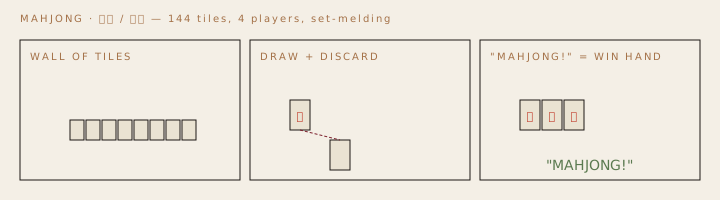
Four players sit at a square table, oriented to the four winds. The dealer — East Wind — varies through the game by turn rotation. After the xishi — the face-down scrub-shuffle — the tiles are stacked into a square wall, two tiles high, eighteen tiles long on each side. The wall is the deck.
The dealer rolls dice to determine where the wall is broken. From that point, each player draws a starting hand of thirteen tiles. (The dealer draws fourteen and immediately discards one to start the round.) The aim is to be the first player to assemble a winning hand of fourteen tiles — typically four sets of three plus one pair — by drawing tiles from the wall and claiming tiles discarded by other players.
A set of three is either a pung — three identical tiles — or a chow — three sequential tiles in the same suit. (Chow is allowed in most regional rule-sets but not all; Hong Kong rules permit it from any player's discard, but Riichi-Japanese rules restrict the chow to the player on your left.)
On your turn, you draw one tile from the wall, then discard one tile. If another player discards a tile that would complete a set in your hand, you can claim it — call pung or kong (four of a kind) or, in some rule-sets, chow — and reveal that set face-up on the table in front of you. The claim interrupts the turn order. You then discard a tile of your own.
Winning is calling mahjong — húle — when you draw or claim the final tile that completes your hand. Some rule-sets require additional conditions (a minimum point value, called fan, before mahjong can be declared) which sustains a long game's strategic depth.
The variants are legion. Hong Kong Old Style uses the simplest scoring. Riichi (Japanese) adds the riichi bet — a declaration of one-tile-from-winning that locks your hand in exchange for bonus points. Taiwanese Sixteen-Tile uses sixteen-tile hands instead of fourteen, and games run longer. Singapore Mahjong incorporates the Animal tiles — Cat, Mouse, Rooster, Centipede — for additional bonus claims. Sichuan Mahjong has restricted-suit rules where the winning hand must be entirely from two of the three suits. The American National Mah Jongg League version (1937 onward, taught to American Jewish women in the mid-20th century by mahjong tutors and now an enduring tradition in American suburbs) has its own annual rule-card.
The classical Chinese game is played in a back room of a teahouse, a corner of a relative's living room, a dedicated mahjong parlour on a quiet Hong Kong side-street. The table is hardwood with a recessed felt centre. The lamp overhead is yellow. The tea is constant. The conversation is everything not about the game — the cousin's wedding, the auntie's gallbladder surgery, the price of pork. The game itself is mostly silent, punctuated by tile claims (pung!, chi!) and the long satisfied sigh of the player who calls mahjong.
What it meant
Mahjong is one of the four foundational Chinese games of memory and skill — alongside Xiangqi (Chinese chess), Weiqi (Go), and the various dice-and-token games — and the only one of the four that became a four-player social game rather than a two-player abstract one. It dates, in its modern tile form, to the late nineteenth century in eastern China — likely the Ningbo region — and spread rapidly through the Qing-dynasty leisure classes before becoming, in the 1920s, a minor international craze (the American "mah-jongg" boom of 1923 sold tens of millions of sets).
The game is the ambient soundtrack of the Chinese New Year. The eight days of Spring Festival — the most important holiday in the Chinese calendar — feature continuous mahjong in nearly every household. Aunts and uncles play through the night while children watch from the doorway and learn the tiles by osmosis. The clack-clack of tiles stacking is the sound of New Year's the way fireworks are the sound of midnight.
It is also a vocabulary game. The names of the tiles — the suits, the dragons, the winds — encode classical Chinese cosmology: Bei nán xī dōng — North-South-West-East — the four directions, the qínglóng-zhūquè-báihǔ-xuánwǔ of Han astronomy, the bāzìmìng of fortune-telling. To learn mahjong fluently is to learn a small dictionary of classical Chinese imagery without ever attending a classical Chinese class.
The cousin games run all the way back: Madiao (16th century, the proposed ancestor), Yezi (Tang dynasty, ancestral card games), and ultimately the same family tree as Western tarot and playing cards. The four-of-a-kind / three-of-a-kind / sequence-of-three logic is itself ancient, appearing in Indian Ganjifa, Persian As-Nas, and many other forms.
The sensitivity is the gambling. Mahjong is most often played for money — small stakes among friends, larger stakes in the back of teahouses, very large stakes in some Hong Kong and Macau parlours. We will be deliberate about this in the digital adaptation: stakes are cosmetic, never real-currency, and the gambling overlays are off by default.
What is lost when mahjong declines: the table itself. The four around it, the four hours, the slow accumulation of family news between tile claims. The grandfather who taught the basics, the auntie whose hand was uncannily fast, the uncle who could read everyone's discards three turns ahead. Mahjong is, beneath the rules, a method by which Chinese families spent time together. Without the table, families have to find another method.
How we'll bring it online
Top-down 3D table with realistic tile physics, full 144-tile set in three regional skins (Hong Kong, Riichi, Taiwanese sixteen-tile). Players choose the rule-set at table creation. Tile-shuffle is a physics-based scrub animation; wall-stacking is automatic but watchable. Tiles draw with a satisfying mechanical click; discards land with the recognisable clack.
Live four-player matches over voice. The voice room is structurally important — mahjong without conversation is just a math problem. Async mode: turn-based, each move (draw, discard, optional claim) pushed to the next player, who has a configurable response window (typically 2 hours for casual, 30 seconds for ranked). Async games stretch over a working week, like the late-1980s pen-pal mahjong by mail among Hong Kong-Toronto diaspora families.
Cosmetic layer: tile-art packs (classical bamboo-and-bone, modern colour-printed, Riichi-Japanese minimalist, American National League decorative, Singapore-with-animal-tiles), table felt colours (jade green, vermillion, tan, midnight blue), tile-back patterns. Voice-line packs include the New Year ambient: firecrackers in the distance, the auntie's gossip about the cousin's wedding, the grandfather sipping tea.
The gambling layer is deliberately only cosmetic. We will not include real-currency stakes. Players bet flowers — virtual tokens with no monetary value — and the winning hand earns a number of flowers proportional to its fan score. Sensitivity-flagged so it does not appear in jurisdictions with strict anti-gambling regulations.
What doesn't translate: the table. The smell of old felt, the warm yellow lamp, the tea. We can mimic the visual; we cannot put four people at the same physical table from four different time zones. Live voice with video-on-overlay (Phase 2) is the closest we get.
Voices
(Pending. Voice memos to be recorded with native speakers from Hong Kong / Singapore / Vancouver Chinatown / SF Bay Area by Phase 1.)


