Senet
The board is wooden and worn, three rows of ten squares, and the pieces are small carved cones — five for me, five for my grandfather. We are in the upper room of a riverside ahwa in Luxor, and the Nile is doing its slow flat thing through the open window. He throws four flat sticks instead of dice — "The pharaohs threw these sticks," he says, every single time. The sticks land. Three flat sides up. He moves three squares.
How it was played
Senet — the oldest known board game still being played — was buried in pharaonic tombs. The Tomb of Tutankhamun (c. 1325 BCE) included a complete senet set; so did Queen Nefertari's tomb at Thebes; so did the tombs of dozens of priests, scribes, and royal courtiers across the New Kingdom and earlier. Boards have been recovered from contexts as old as 3500 BCE — the predynastic period, before there was a unified Egyptian state.
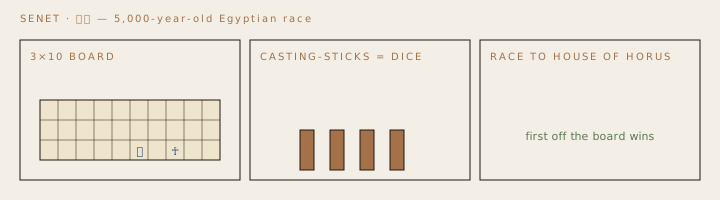
The board is a 3×10 grid — three rows of ten squares, played in a serpentine path: the first row left to right, the second right to left, the third left to right. Some of the squares — typically squares 15, 26, 27, 28, 29, and 30 — are marked with hieroglyphic symbols indicating special game-meanings: the House of Beauty (15, the only safe square mid-board), the House of Water (27, the trap square that sends a piece back), the House of Three Truths (26, where a piece stops until the player rolls exactly three), the House of Two Truths (28, exact two), the House of Re-Atum (29, the second-last square, finished early), and the final exit (30).
Each player has five pieces — pawns, traditionally carved as small cones for one player and small spools for the other. They are placed alternately on the first ten squares of the board at the start.
Movement is determined by throwing four flat sticks (or sometimes knucklebones). Each stick has one flat side and one curved side. The number of flat sides facing up determines movement:
One flat — move 1 (and roll again). Two flat — move 2. Three flat — move 3. Four flat — move 4. Zero flat (all curved) — move 6 (and roll again).
The aim: move all five of your pawns through the serpentine path and off the end of the board — the last square, the House of Horus. First to bear off all five wins.
Rules of conflict: if you land on a square occupied by an opponent's pawn, you swap places — your pawn takes their square, and theirs goes back to the square you came from. There are exceptions for the special squares: a pawn safely on the House of Beauty (15) cannot be displaced. Two of the same colour adjacent on consecutive squares form a protected pair that cannot be displaced.
We do not have a complete original Egyptian rulebook. The rules above are reconstructed from a combination of: late-period inscriptions and game manuals (the Papyrus of Senet found at Saqqara), iconographic evidence from tomb paintings, and modern scholarly reconstructions by Egyptologists Timothy Kendall and R.C. Bell. The rules were almost certainly more elaborate in the original, with religious and afterlife symbolism integrated into the play in ways we no longer fully understand.
The variant that lived on into the modern era — and which my Luxor grandfather plays — is a folk-revival version, taught to him by his own grandfather, with rules that are partly inherited and partly invented as the game was reconstructed in the early twentieth century. There is no continuous tradition from pharaonic senet to modern senet; there is a long gap of roughly two thousand years where the game seems to have died, replaced first by the Roman Ludus Latrunculorum, then by Arabic-period mancala and tab, and finally revived in the 19th and 20th centuries as Egyptology reconstructed the rules.
What it meant
Senet is older than chess by four thousand years. It is older than written history of most of the world. It was played in the courts of the pharaohs and in the houses of ordinary scribes; both kinds of boards have been found.
For the elite Egyptians — the courtiers and royals whose tombs preserved the boards — senet had a religious dimension. The board was understood, particularly from the New Kingdom onward, as a representation of the soul's passage through the afterlife. The pawns moved through dangers (the House of Water, where the soul could drown) and tests (the House of Three Truths, where the soul was judged) before reaching the final union with the gods at square 30. A copy of the Book of the Dead mentions playing senet against an unseen opponent — death itself — for the survival of the soul. In some tombs the boards are accompanied by inscriptions instructing the deceased on how to play.
This sacred dimension is why we flag the game as sensitivity: sacred. Senet in its original cultural context was not merely a parlour amusement. It was, for some Egyptians, a meditation on mortality. We do not approach the digital adaptation as a casual mobile game; we approach it as a recovered ritual artifact, with appropriate restraint about the religious framing.
The game is, in the family of stick-and-track race games, the very oldest known ancestor. Every modern Backgammon, every Pachisi, every Yutnori descends — by paths we cannot fully trace — from the same fundamental impulse that produced senet: race tokens around a path, controlled by random throws, with strategic placement and conflict.
What is lost — what was almost entirely lost — is the original ruleset. Modern senet is a reconstruction. The actual game played by the priests of Karnak in 1300 BCE may have been substantially different from what we play today; we are guessing, in many places, from incomplete evidence. This is a humility we carry into the digital adaptation: we present multiple scholarly reconstructions, label them clearly, and let the player choose.
How we'll bring it online
A 3×10 board rendered with the texture of New Kingdom carved acacia wood. The throwing of the sticks is a swipe-and-release motion that scatters them across a small wooden tray; their flat-or-curved landing is determined by realistic physics. The pawns are textured as small cones (Pharaoh's white) and small spools (Cleopatra's red), with optional skins as tomb-painted hieroglyphic figures.
Live two-player matches with optional voice. Async mode: each throw and move is a turn, pushed to the opponent. We expect the asynchronous mode to be the dominant one — senet is contemplative; a turn a day fits the pace. We support both reconstruction rule-sets — the Kendall reconstruction and the R.C. Bell reconstruction — clearly labelled, with a comparison guide.
The cosmetic and educational layer is heavy: board variants reflect actual museum-recovered boards (the Tutankhamun board, the Nefertari board, the Saqqara papyrus board), each with full historical context provided as optional reading. Hieroglyphic stack-square symbols are clickable for translation. Voice-pack: the soft splash of the Nile through an open window, the call of a Luxor street vendor, the slow rasp of sticks landing on wood.
We will not gamify the religious framing. The afterlife dimension is presented as historical context — a museum panel, not a game mechanic. Where a player chooses to engage with the senet-as-soul-passage interpretation, the game offers respectful annotation; we do not turn the House of Water into a "death penalty" or animate the piece as drowning. The sacred is honoured by being represented soberly.
What doesn't translate: four thousand years. The senet a Luxor grandfather plays today is the closest thing we have to direct contact with a pharaoh's afternoon, but it is still a reconstruction, and we are honest about that.
Voices
(Pending. Voice memos to be recorded with native speakers from Luxor / Cairo / Alexandria by Phase 1.)


