Pétanque
The packed-dirt rectangle behind the café-tabac in a Provence village, the plane trees giving the only shade against the southern afternoon sun, three men in their seventies in linen shirts and the casquette on their heads. A small wooden ball — the cochonnet — has been thrown to the far end. My grandfather rolls his metal boule between his palms, breathes once, and pitches it underhand with the wrist-snap that took him sixty years to perfect. The boule lifts in a low arc, lands a foot from the cochonnet, and rolls in to within two centimetres. "Joli point," the others murmur — a beautiful point.
How it was played
A pétanque match is played on packed earth, gravel, or fine crushed stone — the terrain. The classical terrain is about 12-15 metres long and 3-4 metres wide, but the game can be played on any reasonably flat outdoor surface; village squares, park paths, dirt corners of beach fronts.
The equipment is small and old. The cochonnet (the jack, also called the but, bouchon, or petit) is a small wooden ball about 30mm in diameter, often painted bright yellow or red so it is visible on the terrain. The boules are the throwing balls — solid metal (steel or stainless), about 70-80mm in diameter, weighing 650-800 grams, with patterns or grooves machined into the surface for grip and identification.
Each player has 3 boules in singles, 3 in doubles, 2 in triples. Two teams play; teams can be 1, 2, or 3 players each.
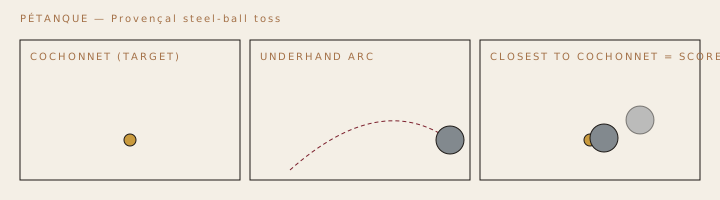
The play. A player from the starting team draws a small circle in the dirt at one end of the terrain — the rond. The first player stands inside this circle (feet together — pieds tanqués, the etymology of pétanque itself — and throws the cochonnet underhand toward the far end of the terrain, between 6 and 10 metres away. This is the target.
The same player then throws the first boule, attempting to land it as close to the cochonnet as possible. They throw underhand, with the palm facing down — a distinctive throwing style — using either a roulade (a low rolling throw), a demi-portée (a medium-arc throw landing about halfway), or a portée (a high looping throw that drops directly onto the target).
After the first throw, the team that is not closest to the cochonnet throws next. They keep throwing until they have a boule closer than the opposing team's closest boule, or until they run out of boules. Then it switches; the other team throws until they regain the closest position. This continues until both teams have thrown all their boules.
When all boules are thrown, the team with the closest boule to the cochonnet scores: 1 point for each boule that team has closer than the opposing team's closest boule. Maximum 3 points (singles/doubles, 6 in triples) per round. Games are played to 13 points.
There are two essential shot types in pétanque strategy:
Pointer — to point. Throw your boule as close to the cochonnet as possible. The classic accurate shot.
Tirer — to shoot. Throw your boule directly at the opponent's well-placed boule and knock it out of position. A successful tireur — shooter — can blast away an opponent's perfect point in a single shot. Top-level tireurs shoot at over 90% accuracy from 8-10 metres.
Most teams have a designated pointeur (the consistent placement player) and a tireur (the aggressive shooter). The captain — the milieu — is often a hybrid, throwing whatever the team's strategic need is.
The pace of play is leisurely. A pétanque match in a Provence village runs forty minutes to an hour, with extended pauses between throws while players measure distances with a stick or — for very close calls — a centimétrage (a small pop-out tape measure carried by serious players). The conversation between throws is part of the game; pétanque without commentary is incomplete.
The setting is village-French. The packed-dirt terrain near the café-tabac. The plane-tree shade. The men in linen and casquettes. A pastis (anise-based aperitif) at the small tables nearby. The petanque-and-pastis combination is the cliché-but-true rhythm of southern French afternoon life.
Variants. Pétanque (above) is the codified modern game, standardised in 1907 in La Ciotat (Provence). Jeu Provençal — sometimes called La Longue — is the older variant, played on a longer terrain (15-20 metres) with a three-step run-up before throwing. Bocce (Italian) is a related game with larger balls and a longer court. The British Lawn Bowls is a more distant cousin played on grass with biased balls. Bochas in Argentina is a hybrid imported by Italian immigrants.
What it meant
Pétanque is the public-park game of southern France. The terrain in the village square is one of the most reliable markers of French rural life; a village without one is a village in trouble. The game is intergenerational — grandfathers play with grandsons, neighbours play with neighbours, the same six men have met every Saturday at the café for thirty years to play a triples match against the same six other men.
The game was codified in 1907 by Jules Lenoir, a Jeu Provençal player who had developed arthritis and could no longer do the three-step run-up; he and a friend invented the pieds tanqués (feet planted together) variant that allowed Lenoir to keep playing. The new variant spread rapidly because it was easier and could be played on shorter terrains; by the 1950s pétanque had displaced Jeu Provençal as the popular form across France.
It taught — teaches — patience and precision. The thrown boule is a single committed action; once the wrist snaps, the trajectory is fixed. The good pétanque player calculates surface bounce, boule spin, terrain slope, and wind in a half-second of focus before the throw. The hand learns a vocabulary that no machine can replicate.
It also taught the village square. Pétanque without the public terrain — without the chance encounter, the slow afternoon, the joining-in of a passer-by — is just a game. With the terrain, it is the social scaffolding of the village. The same logic explains why French boules clubs exist in expat communities everywhere: in Quebec, in Tahiti, in San Francisco's Marina Green, in Singapore's Holland Village. The terrain travels because the social form travels.
The cousin games span Mediterranean Europe — Italian Bocce, Croatian Boćanje, Catalan Bitlles, Spanish Petanca, the British Lawn Bowls and Crown Green Bowls. The lineage runs back to ancient Greek spheristerion and Roman terra-cotta-ball games. Modern pétanque is the southern-French codification, and the most internationally tournamented (the Confédération Mondiale des Sports de Boules and the Fédération Internationale de Pétanque et Jeu Provençal run world championships).
What is lost when pétanque declines: the terrain. Village terrains are still common in southern France but the urban replacement rate is poor; new neighbourhoods rarely include a packed-dirt rectangle. The game survives in the established villages and in dedicated city clubs (the Place Dauphine in Paris, the Square Boucicaut, the corner of every Marseille park).
How we'll bring it online
Top-down 3D terrain view, with realistic packed-dirt texture and visible surface variation that affects roll. The throw is a tactile, calibrated gesture: drag the boule in the direction and force of intended throw, with on-screen indicators for arc style (roulade, demi-portée, portée). The boule lands and rolls with realistic physics, with friction and bumps modelled from real terrain surface scans.
Live two-player (singles), four-player (doubles), or six-player (triples) matches over voice. The voice room is essential — pétanque commentary, the slow conversation between throws, is half the experience. Async mode is excellent for pétanque because the pace is naturally slow; a turn a few hours fits the rhythm.
The tirer shot — the precision-shooting move that knocks an opponent's boule out of place — gets a dedicated mini-game with high-precision aiming, given how skilful and dramatic the shot is in real pétanque.
Cosmetic layer: boule designs (classical Obut steel, modern stainless, vintage hand-machined patterns, regional artisan editions from Marseille, Lyon, La Ciotat), terrain surfaces (Provence packed-earth with plane-tree shade, Paris park gravel, Toulon coastal grit, Quebec packed-snow variant for diaspora), cochonnet colours and designs. Voice-pack: the village ambient — cigales (cicadas) in the plane trees, the café radio playing chanson, southern French commentary in Marseillais and Provençal dialects.
What doesn't translate: the pastis. The anise-and-water aperitif at the small table by the terrain. The cigarette smoke. The plane trees. Pétanque is the soundtrack of a specific southern-French afternoon, and the terrain is the song; we can render the terrain but the air around it requires the actual village.
Voices
(Pending. Voice memos to be recorded with native speakers from La Ciotat / Marseille / Toulouse / Quebec by Phase 1.)


