Conkers
A horse-chestnut on a string. The dark-glossy brown nut, drilled through the centre with a kitchen skewer my mother had warned me not to use, threaded with a length of dirty white shoelace knotted at the bottom. I am eight, in the playground of a primary school in Northamptonshire, and the September cold is making everyone's noses red. My friend Ian holds out his conker on its string, lets it dangle still. I swing my own conker overhand and aim for his. Whack — and his conker shatters into three pieces of pulpy white meat. "Tenner!" the boys around shout. My conker is now a tenner.
How it was played
A conker is a horse-chestnut — the seed of the Aesculus hippocastanum tree, a glossy dark-brown spherical nut about an inch across, found in spiny green husks that fall from the tree in autumn. The horse-chestnut tree is common across Britain and Ireland; in October the conkers carpet the ground under any mature specimen.
You collect conkers — the best are the ones that have just fallen, hard and dense and heavy. You take them home. You drill a hole through the centre with a skewer, a meat-thermometer, or a hand-drill if your dad has one in the shed. You thread a length of string through the hole — traditionally a shoelace, a piece of garden twine, or a strip torn from a school sock — and knot the bottom end so the conker hangs at the end of about a foot of string.
That is your weapon.
Two players each have one conker on a string. They face each other.
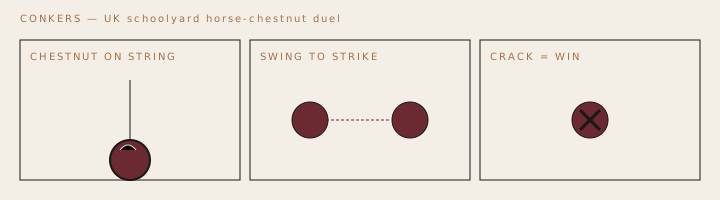
One player is the defender. They hold their string at the top, letting their conker hang motionless at the bottom, about chest-height, perfectly still, swinging slightly in any breeze. The other player is the attacker. They wrap their string around their fingers, draw the conker back over their shoulder, and swing it down hard at the defender's conker.
If they hit it cleanly, both conkers usually take damage. If the attacker misses entirely, they get one more attempt; three misses and roles swap. If the strings tangle (a common problem) — strings! — the player who calls it first gets a free strike on the next round.
You alternate roles — strike, defend, strike, defend — until one of the conkers shatters. Whoever is still holding an intact conker wins.
The scoring is the part that made it a real game. Your conker accumulates wins. Each opponent conker it has destroyed adds one to its kill count. A conker that has won one match is a one-er. Two matches, a two-er. Five matches, a five-er. Ten matches, a tenner — a serious accomplishment. There were folkloric fifty-ers and even hundred-ers in school playground legend, though most playground experience suggests these were exaggerated.
Crucially, when your conker beats another conker, your conker absorbs the loser's score. If your three-er beats your friend's seven-er, your conker is now a eleven-er (3 + 7 + 1 for the win). This is what made the game so addictive; a single great match could vault an unknown conker to legend status.
The hardening rituals were extensive and largely cheating. Some boys soaked their conkers in vinegar overnight. Others baked them in the oven. Others coated them in clear nail polish. Others — the desperate — drilled a tiny hole and injected superglue. The official tournament rules (yes — there was a World Conker Championships, held annually in Ashton, Northamptonshire, since 1965, until it briefly paused in 2020) prohibited any such hardening; players had to use natural conkers from a communal pile. School-yard conkers had no such enforcement, and a suspiciously hard conker could be subjected to a taste test — opposing players would scrape a corner with a fingernail to see if the wood was natural.
The season was tight. Conkers fell in late September and early October. The school conkers season ran from the first week of October to the half-term break in late October. After half-term the conkers were too dry, too brittle, and the season was effectively over. Three to four weeks of intense play, then nothing for eleven months.
Variants by region. Conkers in England and Wales. Conkers in Ireland. Cobblers in some parts of Yorkshire and the West Country. The Scottish term was sometimes chestnuts or checkers. The American cousin — also played, but never with the same intensity — was buckeyes with the related Aesculus glabra (the Ohio buckeye). Continental Europe has occasional Maronnier games but with much less folkloric weight.
What it meant
Conkers is the autumn ritual of British and Irish primary-school childhood. For three to four weeks each October, every playground turned into a small horse-chestnut warzone. The game was free — conkers cost nothing to gather — and democratic — any kid could play, regardless of background — and seasonal in a way that almost no modern children's game is. The cycle of waiting, gathering, preparing, playing, winning-or-losing, ending mapped a kind of agricultural year onto the school calendar.
It taught — perhaps still teaches, in the schools that haven't banned it — risk and craft. The hardening rituals taught small children that you could prepare yourself for combat. The strike technique taught aim and follow-through. The kill-count system taught that real possessions accumulated value through use, that a battered conker with five kills was worth more than a fresh one with none. This is a real economic lesson, learned with autumn leaves under your shoes.
It also taught the season. British children of the 1950s through the 1990s had a calendar that included conkers in October, bonfires on November 5, and Christmas in December. The seasonal ritual marked the year. Modern children, with year-round indoor games and screens, have lost much of this seasonal scaffolding. Conkers in October was a piece of when-time-itself-felt-real.
The cousin games are the wider European chestnut-and-acorn games, the American buckeyes, and more distantly the global tradition of strike-and-shatter small-object combat games. Conkers is uniquely British in that it became a legitimate competitive sport (the World Conker Championships in Ashton) while remaining primarily a children's playground tradition.
What is lost when conkers declines: the autumn. Many British primary schools have banned conkers in the last twenty years on health-and-safety grounds (a child might lose an eye, a child might injure another child) — sometimes with mandated safety goggles, sometimes outright. The horse-chestnut tree itself is also declining; the bleeding canker disease and the horse-chestnut leaf miner moth are killing mature horse-chestnuts across Britain. Some October playgrounds now have no conkers because there are no conker trees left. The game is fading, and the trees are too.
How we'll bring it online
Two side-on views: defender's conker dangles, attacker swings. The strike is a vertical drag-and-release gesture with calibrated force and angle. The collision is rendered with realistic physics — a hard-strike-on-weak-conker animation differs visibly from a glancing-strike-on-hardened-conker. The shatter is a satisfying crack-and-spray of conker fragments.
Live two-player matches over voice. Async mode: each player records a strike-or-defence pose, and the next player responds when they wake up. Excellent for diaspora British/Irish families who want the autumn ritual without the autumn.
The defining feature is the conker as persistent object. You collect virtual conkers each October — only in October, season-locked — by tapping virtual horse-chestnut trees on a daily walk. Each conker has a kill-count, a hardness rating, and a visual wear pattern that reflects its match history. A tenner conker looks different from a fresh one — pitted, slightly darker, scarred. Your collection persists year-over-year.
The hardening mini-game is included as a satirical nod: you can virtually soak your conker in vinegar, bake it, or coat it in nail polish, and these affect its hardness — but at high tournament levels the rules forbid hardening, and a conker that has been hardened is marked as such for tournament play.
We season-lock the live multiplayer to October only. From November to September the game is unavailable except in single-player practice. This is a design choice, not a limitation — the seasonal scarcity is the experience. You wait. You anticipate. October arrives.
Cosmetic layer: conker variants (classic English horse-chestnut, Irish-mossy variant, vintage 1950s nail-polish-coated, modern tournament-grade, rare tenner+ champion conkers with visible scars), string types (old shoelace, garden twine, sock-strip, regulation tournament cord), playground settings (Northamptonshire primary 1985, urban school 2025, rural Welsh village). Voice-pack: the schoolyard ambient — bell ringing, kids shouting "Strings!", the ten-er-fifteen-er-twenty-er chant when a high-kill conker takes another win.
What doesn't translate: the actual horse-chestnut. The smell of the cracked-open spiny green husk, the feel of the hard glossy nut still warm from a pocket, the satisfaction of finding a perfect heavy one under a London plane tree. The game is digitisable; the autumn is not.
Voices
(Pending. Voice memos to be recorded with native speakers from Northamptonshire / Belfast / Edinburgh / Dublin by Phase 1.)


