Antakshari
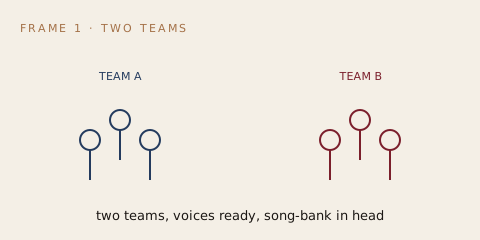
Power cut at nine, candles on the centre table, and twelve cousins crammed into the drawing room because there was nothing else to do. The first cousin clears her throat. "Pehla akshar… Sa." And someone, somewhere — usually the auntie who had once auditioned for Doordarshan — would launch into "Sajan re jhooth mat bolo…", and the next two hours of your life were decided.
How it was played
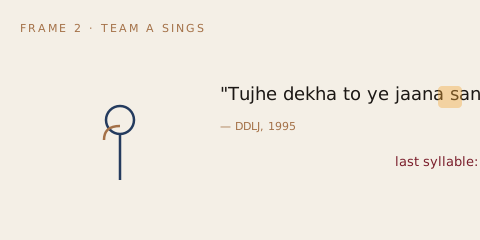
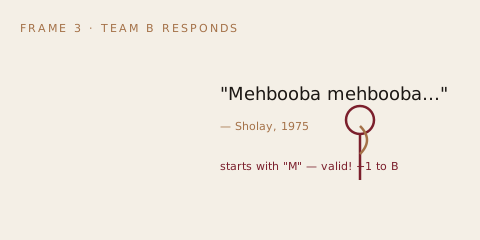
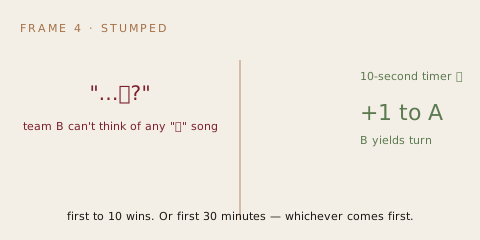
The rule is in the name. Ant-akshar — the last letter. One team sang a Hindi film song. When their song ended, the other team had to start a new song beginning with the last consonant-sound of the previous one. "Mere sapno ki rani kab aayegi tu…" ends on tu. So the next song must begin with T. "Tujhe dekha to ye jaana sanam…" ends on m. So the next must begin with M. "Mehbooba mehbooba…". And on, and on, until someone stalled, and the team that stalled lost the round.
You sang at least the mukhda — the first verse and the chorus. Half a line wasn't enough; the elders called out "poora gaao!" — sing it whole. If a song was too short or too obscure, the opposing team could challenge — "yeh gaana hai hi nahi" — that's not even a song — and a panchayat erupted, three uncles arguing whether Aandhi (1975) had a song that started with Gha. The grandmother on the corner sofa was usually the supreme court. If she said the song existed, it existed. If she didn't remember it, it didn't.
There were silent rules everyone knew. Repeating a song already sung that night was a foul. Bhajans counted but were considered slightly unsporting — too easy, too many Ram and Krishn lifeboats. English songs were banned in the strict households, allowed in the cool ones. Ghazals were a power move because once Begum Akhtar entered the room, nobody dared challenge. And the deadliest letter, the one nobody wanted, was Aen — the Urdu ain, that dropped you into a list of maybe six songs from the entire history of Hindi cinema.
The format was loose. Sometimes it was two teams sitting opposite each other. Sometimes the whole train compartment played, with strangers from Lucknow and Allahabad and Patna joining in by the time you crossed Mughalsarai. On long Diwali nights, the game lasted until daadi fell asleep mid-verse and the kids tiptoed away with the leftover mathri.
Scoring depended on the household. Strict ones used a chalk-on-slate tally — one point per song, two if you started the round, minus two for a repeat. Loose ones forgot the score halfway through and just kept singing because the singing was the thing.
There was always one cousin who didn't know any songs and kept whispering hints to her partner. There was always one uncle whose voice cracked on the high notes and got laughed at the entire week after. There was always the moment when somebody started "Aaye ho meri zindagi mein tum bahaar ban ke…" and the whole room — three generations of it — joined in, and for four minutes the power being out was the best thing that had happened all month.
What it meant
Antakshari is the only game I know where the songs you grew up hearing become the equipment. There is no ball, no board, no token. There is just the inheritance of melody — what your daadi sang to your father, what your father played in the Maruti 800 on the way to school, what RD Burman composed when nobody could imagine anything bigger than RD Burman.
It is also, secretly, a memory device. The Indian film industry has produced something like fifty thousand songs since 1931, and Antakshari is how that catalogue got passed across generations without anyone teaching it deliberately. A nine-year-old learns "Lag jaa gale" not in a music class but because it was Round 4 and her aunt sang it and the chord change made the room go quiet. That is how culture used to transfer — through games, not curricula.
Cousins of this game live across the subcontinent. Bait Bazi in Pakistani Urdu households uses Urdu couplets instead of film songs. Shumukh and Mushaira echo the same chain-of-last-letters logic with poetry. The Tamil Padappattu and Bengali Antakshari both adapted the format with regional film catalogues. Internally to India, Antakshari is one of the rare games that crosses every linguistic line — Punjabis, Bengalis, Marathis, Malayalis can all sit on the same floor and play the Hindi version, then switch to the regional version when the room shifts.
What disappears when Antakshari disappears is a specific kind of cross-generational intimacy. My grandmother could not teach me Urdu in any classroom way, but she taught me "Inhi logon ne le lina dupatta mera" in a single round of Antakshari, and I have known the word dupatta in three meanings ever since. There is no app that can replicate her voice. But there can be an app that gives my niece in New Jersey something close to the room.
How we'll bring it online
Live voice room with rotating turn-orders, the way it actually felt. Two teams, three to seven a side, each player gets a thirty-second window to start their song after their team's pick. Speech-to-text matches the mukhda against a curated catalogue of 12,000 Hindi/Urdu/Punjabi/Bengali film songs spanning 1940-2025; the engine extracts the last akshar automatically and shows it to the next team. Disputes can be raised — a "challenge" button triggers a 15-second poll where any player can support or reject; majority rules, no uncles required.
Async mode is a side-by-side recording battle: you record your mukhda, the next player records theirs, and the chain plays back as a continuous medley with every voice stitched together. We are deliberately not auto-tuning. The cousin who can't sing must still get to play.
Catalogue packs are the cosmetic layer: Golden Era (1950-69), RD/Kishore (1970-89), Yash Chopra Romance (1989-2004), Indie/Coke Studio (2010+), Lollywood (PK), Bangla Cinema (BD), Tamil/Telugu (regional unlock). Voice-line packs add the room sounds — the auntie clapping, the grandmother saying "poora gaao", the cousin laughing.
What doesn't translate: the power cut. We can fake the candle ambience with shaders. We cannot fake the reason everyone was in the same room.
Voices
(Pending. Voice memos to be recorded with native speakers from Lucknow / Karachi / Kolkata by Phase 1.)