Carrom
The board lived on top of the fridge or under the bed, and the powder lived in a small steel dabba nearby. Boric. The smell was sharp and slightly sweet, and you knew the game had started when somebody dragged the board onto the dining table, sprinkled the powder in three crescent arcs, and rubbed it in with the heel of their palm until the wood went silent under the coins.
How it was played
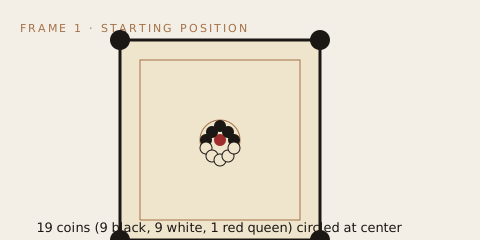
A square board, about three feet on a side, with four corner pockets shaped like little nets — sometimes wood, sometimes a frayed cotton mesh that had been re-stitched twice by the grandfather. Nineteen flat coins: nine white, nine black, and one red. The red one was the Queen, and the whole game revolved around her.
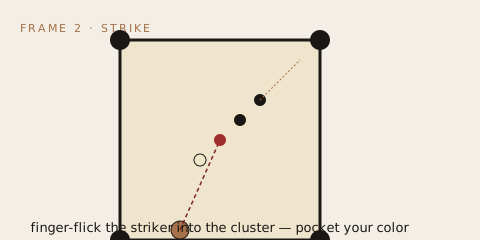
You arranged the coins in a circle at the centre — the Queen in the middle, white and black alternating around her like the petals of a flower. The striker was a slightly larger, slightly heavier disc, and you flicked it from your baseline using your index finger, your middle finger, or — if you were the kind of player who took the game seriously — a curled-thumb-and-forefinger snap that nobody under twelve could reproduce.
Singles had two players sitting opposite each other; doubles had four, partners diagonally across. You played from your own baseline only. White and black were assigned by the break — whichever colour went into a pocket first, that team got. From then on, you pocketed your own colour. Hit any opposing coin into a pocket and it was a foul: you returned one of your already-pocketed coins to the board, and the opponent placed it wherever they wanted (usually right next to your pocket).
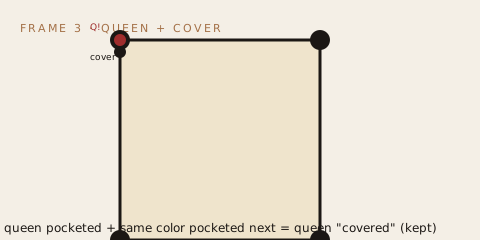
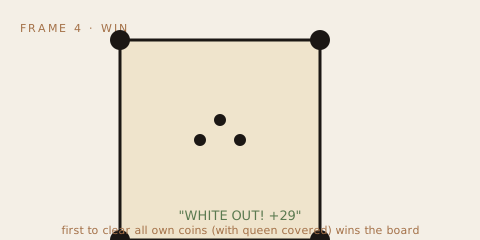
The Queen was the prize. To win her, you pocketed her, and on your very next strike you had to pocket one of your own coins — this was called "covering" the Queen. If you didn't cover, the Queen came back to the centre. Pocketing the Queen and your last coin in the same shot was the cleanest victory anyone could have, and the kind of thing that got talked about for two weddings.
The rules drifted by neighbourhood. In Bombay you could re-flick the striker if it didn't cross the front line — three tries, then forfeit. In Madras every coin pocketed earned an extra strike; in Lahore the limit was two consecutive extras. In some Bangladeshi villages the Queen was called Rani and she was worth five points if covered, three if uncovered. In Sri Lankan tea estates the board was sometimes painted with film stars in the corners — Sivaji Ganesan, Rajinikanth, MGR — and pocketing a coin in a corner you "owned" was double points.
Boric powder was the religion. Not enough and the coins dragged. Too much and the striker skidded off the board. The right amount was a thin film, applied between every break, that made the board go from matte to silk-shine. Some players used talcum. Some used corn starch. The purists, the ones who had played for years on the same warped board with the corners chipped, used only fresh boric from the chemist on the corner.
The arguments were fierce and instant. Did the striker leave the line cleanly? Did the coin actually go in or just rest on the lip? Did your sleeve brush the board mid-shot? In doubles, your partner's silence was your loudest critic.
What it meant
Carrom was the indoor monsoon game. When the courtyard was wet and the cricket was rained off, the board came down. It was also the hostel game, the railway-quarters game, the chai-shop game, the barbershop-waiting-room game. In any place where four men had thirty minutes and nowhere to go, a Carrom board appeared. The clack of the striker on a coin is one of the most specific sounds in South Asian sonic memory — sharper than dominoes, softer than a snooker break, and impossible to mistake.
It also taught patience. The good Carrom player didn't always go for the hardest pocket. He played the cushion — bouncing the striker off the back rail to set up the next shot. He played defence — leaving his coin so close to a pocket that the opponent couldn't strike without giving it away. The game rewarded the boy who could see two shots ahead, not the one who hit the hardest.
There is a version of Carrom in nearly every country it travelled to. The British took it from Mysore to England in the 1880s, Sri Lankans codified the modern doubles rules, and the International Carrom Federation now hosts world championships every two years where the South Asian diaspora dominates. But it is still, fundamentally, an indoor family game. The professional version is just an echo of the room.
What's lost when Carrom goes is the long, slow afternoon. Modern apartments are smaller; nobody has a board on top of the fridge anymore. The kids have phones. The grandfathers who used to teach the curled-thumb snap have died. The game persists, but mostly on tournament tables among men who were already trained, not in the next generation's drawing rooms.
How we'll bring it online
3D physics-driven board with realistic wood-and-coin friction modelled from real boric-powdered surface tests. The strike is a touch-drag-release: you place the striker on your baseline, drag back to set angle and power, release to flick. The aim line shows for the first three games, then disappears — we want the muscle memory, not a billiards trainer.
Singles and doubles, both live. Doubles voice-room mandatory because Carrom doubles without partner-talk is just two people taking turns. Async mode lets you take a shot, the opponent responds when they're free, and the board state syncs — a single match might span a working week, just like the office-canteen Carrom of the eighties.
Cosmetic layer: board skins (Mysore rosewood, Sialkot teak, Sri Lankan painted-corners with regional film stars), coin sets (classic ivory-white-and-black, modern neon, brass-and-copper for the festival edition), powder-spray animation in three tints. Striker skins as Phase-2 unlocks. Voice-pack: the sound of the chemist-shop boric dabba opening, the thup of a coin in the corner-net, the uncle saying "abey covering!" when you forget to cover the Queen.
What doesn't translate: the smell. We can show the powder cloud. We cannot push that astringent boric scent through a screen, and that's the one thing every player remembers first.
Voices
(Pending. Voice memos to be recorded with native speakers from Chennai / Karachi / Colombo by Phase 1.)