Gilli Danda
A short stick on the ground. A longer stick in your hand. You tap one end of the small stick — the gilli — and it lifts an inch, and in that inch your whole afternoon happens. The thwack of the danda meeting it mid-air is the sound of every village summer ever recorded.
How it was played
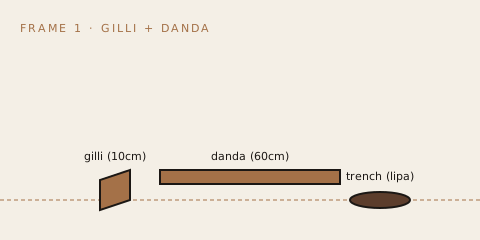
Two pieces of wood. The gilli, about four inches long, both ends shaved into a point so it looked like a tiny rugby ball. The danda, about two feet long, smooth, the thickness of a child's wrist, sometimes a piece of broken cricket-bat handle, sometimes a length of bamboo, sometimes — in the proper villages — a custom-cut piece of mango wood that had been in the family for two summers.
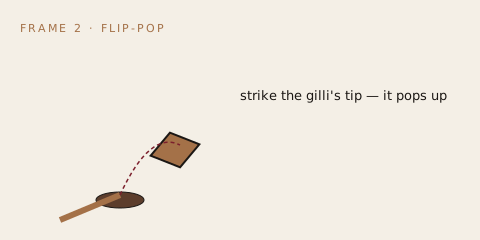
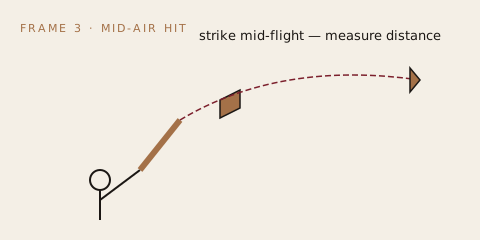
You drew a small oval pit in the dust, four inches long. The gilli rested across the pit. The striker lay the danda flat on the ground beside it, flicked the gilli up off the pit's edge with the danda's tip — a tap-and-lift motion called the tippi — and as the gilli hung in the air, you swung the danda like a bat and hit it.
If you missed, you were out. If the fielders caught the gilli in mid-air, you were out. If the gilli landed in the field and a fielder threw it back into the pit while you were running, you were out. If none of those happened, you got to score.
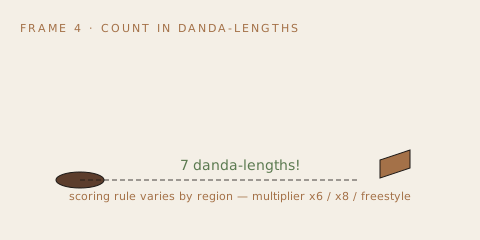
Scoring was the surprising part. After the hit, you measured the distance from the pit to where the gilli had landed — but you measured it in danda-lengths. The striker would lay the danda on the ground, mark its end, lay it again, mark again, all the way to the gilli. Each danda-length was one point. A really clean hit could rack up twenty points. A weak hit, three.
But there was a second-stage shot — and this is what made Gilli Danda Gilli Danda. Once the gilli had been hit, before the fielder picked it up, the striker could choose to pucca it — a special second strike where you tapped the gilli mid-air a second time with the danda, and then hit it on the bounce. A successful pucca doubled the score. A failed pucca — and most of them failed — meant zero for the entire turn.
You played in two teams of three to six, taking turns batting and fielding, like a stripped-down village cricket. The pitch wasn't a pitch — it was whatever maidan had open ground, sometimes a road that had to be cleared every time a tractor passed. The boundary was a chalked line, a row of stones, or just "as far as the neem tree." Innings ended when every batter on a team had been out. Highest total wins.
The variants are wide. Maharashtrians call it Viti Dandu and use a slightly shorter striking stick. Bengalis call it Danguli and the gilli is sometimes square instead of pointed. Tamils call it Kuttiyum Kolum and the scoring is in steps walked, not danda-lengths. In the Punjab the gilli is sharpened harder and flies further; in Sindh the danda is heavier. In Lahore I once watched a man hit a gilli over the wall of an entire mohalla — twelve danda-lengths, a record for that street, and the kids talked about it for weeks.
There were rules nobody wrote down. If the gilli hit a window, the game paused while you negotiated with the auntie who came out shouting. If a buffalo wandered onto the pitch, you waited. If the gilli fell into a drain, you fished it out with the danda and wiped it on your shirt and kept going.
What it meant
Gilli Danda is older than cricket. Some historians trace it to references in the Mahabharata; others to Persian and Mughal accounts. The British saw it played across the subcontinent in the 1800s and called it Tip-Cat, exporting a thin version of it back to England. Cricket, in a sense, is what happened when British colonial administrators took the village game home, formalised it with a pitch, eleven players, and white clothes, and forgot where it came from. Every Indian village kid who ever picked up a danda before he ever picked up a cricket bat was, without knowing it, holding the older version of the same idea.
It taught timing. A gilli in the air is a moving, spinning, falling target — you have a quarter of a second to swing — and the kid who could hit it cleanly was the kid who, four years later, would dominate inter-school cricket. Yuvraj Singh has talked about Gilli Danda as the foundation of his hand-eye. Kapil Dev grew up on it.
It also taught geometry. Where will the gilli fall? How will it spin? Should I pucca it or take the safe score? These are the questions that carry over into every striking sport. The boys who learned them at age seven on a maidan in Bareilly carried them into their thirties.
What's disappearing: the open ground. The gulley games are dying because there are no gulleys — every flat patch is parking, every maidan is being eyed by a developer. Gilli sticks aren't sold anywhere. You make them, or you don't play.
What's lost when the game disappears is the village's relationship to its own time. Gilli Danda took a whole afternoon. The pause when a buffalo crossed. The negotiation with the auntie. The slow walk to retrieve a gilli from the neem tree. None of that translates to a phone game played in a fifteen-minute commute.
How we'll bring it online
Side-on 2.5D pitch. The strike is two-stage — a tap to lift the gilli, then a swipe to time the swing, then a precision-window mini-game for the optional pucca. Distance is measured in animated danda-lengths laid one after another along the ground after each hit, with a satisfying counter rolling up the score. Fielders are AI in solo, real players in multiplayer.
Live two-vs-two and three-vs-three. Async cricket-style innings: you bat your turn, push the result to your teammates, they bat theirs, opposing team responds when they wake up. A village-format inning can take three real days, which is exactly right.
Cosmetic layer: danda wood (mango, neem, sheesham, bamboo), pitch surfaces (dust, stubble-field, packed earth, monsoon-mud), boundary art (chalked, stoned, neem-tree-line). Voice packs in Hindi, Punjabi, Marathi, Bengali, Tamil — including the auntie shouting from the verandah, the cousin yelling "pucca maar!", the thwack of wood on wood at three different sizes.
What doesn't translate: the hit. The proprioceptive jolt up your forearm when the danda meets the gilli in the air, clean and centred — there is no haptic engine in any phone that can give that back. We don't pretend.
Voices
(Pending. Voice memos to be recorded with native speakers from Bareilly / Lahore / Pune by Phase 1.)