Kanche
A small glass marble in your fist, the cool weight of it against your palm, the swirl of colour — milky white with a green twist, blood-red with a yellow eye, a clear one with a tiny seahorse of bubbles trapped inside. You crouched in the dust outside the school wall, drew a circle with a stick, and the world shrank to the size of a thumb-flick.
How it was played
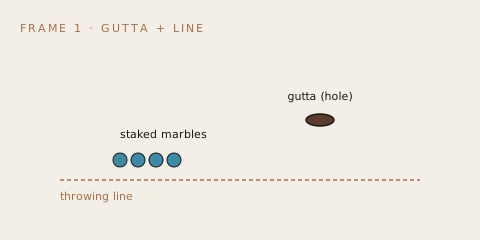
The marbles came from the kirana shop in a paper packet of ten for one rupee, or — if you were lucky — from a cousin's hand-me-down tin that had thirty different patterns and one perfect daddy (the big one, twice the size of normal, used for advanced shots). You pooled them into a circle drawn in the dust, two feet across. Each player put in an agreed number — usually three. The pool sat at the centre, glittering.
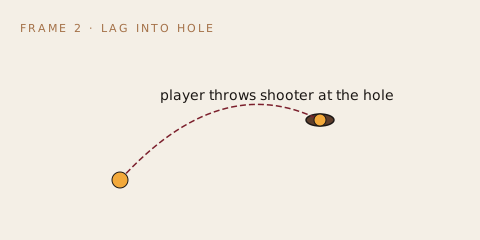
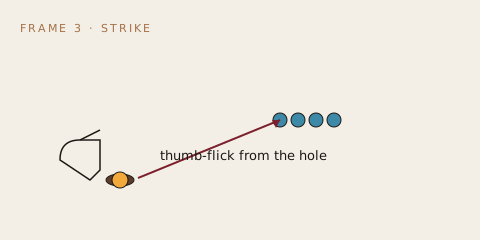
The shooter knelt at a striking line a few paces away. The classic shot was the thumbo — middle finger and thumb forming a small ring, marble balanced on the bent index, then a hard thumb-flick that sent the marble skating across the dust. A clean strike knocked one of the pool marbles out of the circle. Whatever marbles you knocked out, you kept. If your shooter stayed in the circle, you lost it. If your shooter missed entirely, you waited.
There were variants for every kind of kid. Goli kanche: the simple knock-out described above. Daanka: you tried to land your marble inside a small dug pit at the centre of the circle — landing in the pit won the entire pool, but missing meant your marble was forfeit. Lambi maar: a long-distance version where the circle was four metres away and the kids who could shoot straight from that range were minor legends. Eklingi: a one-on-one duel — two shooters, one pool of three marbles, alternating shots until one was empty.
The grip was the first thing you learned. Wrong grip and the marble dribbled. Right grip — knuckle hard against the dust, thumb cocked and tight against the index — and the marble flew flat and fast. The boys who could shoot from a low knee with a flat trajectory were the ones who emptied other kids' pockets by lunchtime. Some used a chalk-line as the shooting boundary; others used a piece of frayed string; the most serious carved a groove with a stone.
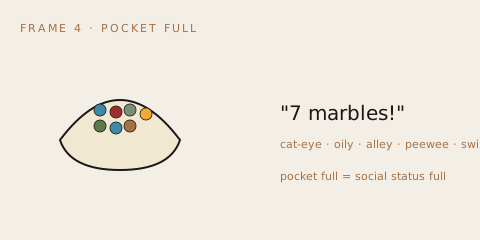
You carried your marbles in a cloth bag tied at the top with a rubber band. The bag rattled when you walked, and a rattling bag at recess was a challenge to anyone who heard it. "Khelega?" — Will you play? — was a question that started a hundred fights and a thousand friendships.
There were sub-rules that drifted from gully to gully. In Hyderabad if your shooter rested on top of an opponent's marble (a piggyback) without knocking it out, the opponent had to pay you one. In Lucknow the daddy marble was banned in beginner games — too much momentum. In Karachi the dust circle was sometimes replaced by a chalked square on the galli concrete, which made the surface faster and the angles meaner. In Kolkata the game was called Goti and the shooter was a fat clay marble, not glass, because clay didn't roll out of the boundary as easily.
Losing all your marbles was a real, public humiliation. Going home with an empty bag meant an empty pocket, and you waited until next week's pocket money to buy more from the kirana. Winning ten marbles in a single recess was a story that lasted a month.
What it meant
Kanche was the first economy most boys ever participated in. Real, scarce, recoverable assets. You won, you lost, you saved your best marble (the swirly red one, named — every kid had a name for their best marble) for the championship round on the last day of school. There were no parents, no umpires; the dust circle was an autonomous republic governed by the loudest voice and the most accurate flick.
It taught hand-eye coordination at a depth that no app has yet matched. A good Kanche player calibrated angle, weight, friction, dust-density, and finger-strength every single shot. Olympic shooting champions from India have given interviews where they trace their first sense of aim to a marble pit in a Bhopal alleyway.
Cousin games exist everywhere — Marbles in England, Canicas in Spain, Ohajiki in Japan (with smaller flat discs), Klikkers in the Netherlands. The Indian version is distinctive in two ways: the dust circle as the playing surface (most Western marbles is on tile or pavement), and the social asymmetry of the shooter — the daddy marble, the piggyback rule, the boundary-line drift.
Disappearing? Almost gone. Glass marbles still get sold in Sadar Bazaar, but kids don't crouch in the dust anymore. Concrete and cars killed the gully. The only place I've seen kids playing Kanche in the last five years is in small-town Bihar and on Doordarshan reruns of old Mukul Anand films.
What's lost: the calibration. The slow, patient learning that a flick is a calculation. A kid who has never crouched and aimed at a glass marble two feet away has missed something specific about how their fingers can talk to the world.
How we'll bring it online
Top-down 3D dust circle. The shot is a slow-motion drag — pull back the marble, set angle, set power via finger-pressure-time on touch, release. The arc of the shot is realistic-ish: we model spin and bounce, but we exaggerate it slightly so the satisfying clack of contact reads big on a phone speaker.
Live mode: two-to-six players around a single circle, taking turns. Async mode: each shot is a recorded animation; you watch the opponent's last shot when you open the app, then take yours, then push back. Matches can span days. The pool of marbles is real ownership — you collect cosmetic marbles across matches, build your bag, and your bag is visible to opponents before a match starts.
Cosmetic layer is the heart of the game. Hundreds of marble skins: classic Indian milk-glass, the swirly red, the seahorse-bubble clear, the blood-red yellow-eye. Regional variants: clay gotis from Bengal, ceramic from Karachi, frosted ones from Sri Lanka. Limited drops on Diwali, Eid, Holi. The daddy marble is a Phase-2 advanced unlock.
What doesn't translate: the dust on your knees and the way the marble felt cool in a hot afternoon palm. We can mimic the click. We cannot give back the crouch.
Voices
(Pending. Voice memos to be recorded with native speakers from Hyderabad / Lucknow / Karachi by Phase 1.)