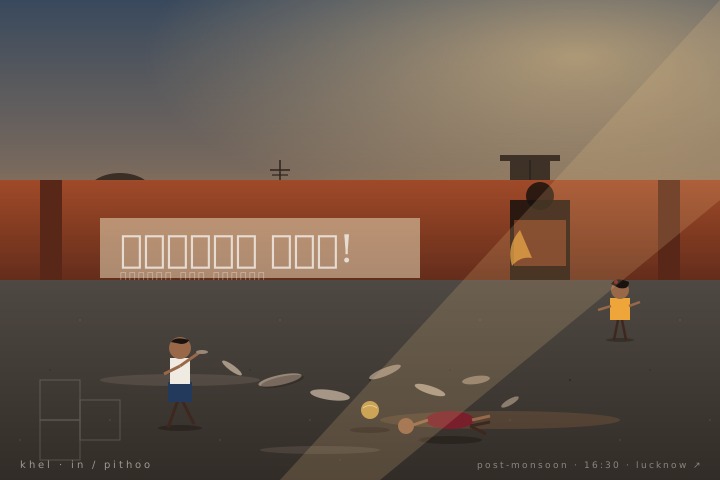
Pithoo
Seven flat stones, an old tennis ball, and grass-stained shins. Every Indian schoolyard had its tower. Every Punjabi gully had its shout — "Pithoo!" — when the seven stones came back into a stack on the dirt.
How it was played
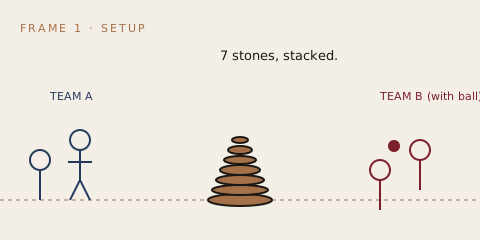
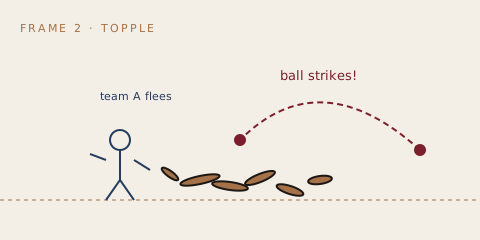
You stacked the stones on the touchline. Smaller one on top, fattest on the bottom — the kind of stack you'd see at the corner of a temple, except this one only had to last a minute. The two teams divided up. One team — the "out" team — threw a soft ball at the tower from a chalked line ten metres away. Three throws each. If they failed, the other team won by default. If they hit the tower, the stones scattered, and so did everyone.
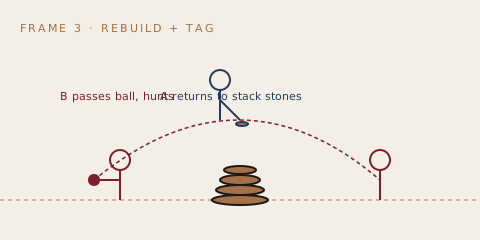
Now the chase began. The team that had thrown the ball had to grab it and tag any of the rebuilders — anywhere on the body, but most kids aimed for legs because nobody wanted to argue about whether the ball had touched a forearm. Meanwhile, the other team — the "in" team — had to rebuild the tower while staying alive. Each of them had a job: one would scoop a stone and run for the centre, one would draw the throwers' attention, one would feint towards the ball-bearer to make them release. The smallest player almost always rebuilt; their hands were quickest with the small stones at the top.
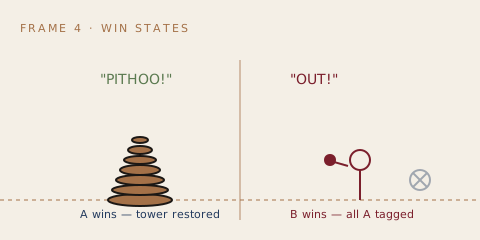
A successful stack triggered the shout: "Pithoo!" — sometimes "Pithoo Garam!" (literally "hot Pithoo," meaning the tower is alive again), sometimes the regional alternative "Lagori!" in Karnataka, "Sitoliya!" in Rajasthan, "Sat-Toliya" in Maharashtra. If a player got tagged before the rebuild was done, that player was out, and the team kept going with one fewer body. If everyone got tagged before the rebuild, the throwers won.
Best-of-five was standard. There were no umpires; arguments were settled by the loudest grandmother on the verandah, or by the next round.
The rules drifted by neighbourhood. In Old Delhi the throwers had to bowl underarm, "like Wasim Akram." In Lucknow you needed exactly seven stones — six wasn't legal. In Karachi the soft tennis ball was sometimes replaced with a gendi ball wrapped in cloth, which hurt less and bounced less. In Dhaka the game was called Daria-Bandhi and the stones were sometimes pieces of broken brick. Every variant had its own boundary lines, its own forfeit rules, its own laughter.
What it meant
Pithoo was the first team game most Indian kids ever played. It taught you that a tower is built one stone at a time, that you can run faster when someone you love is being chased, and that the smallest kid in the group is sometimes the most important. It was the school-ground monarch — the game everyone played at recess until the bell rang and everyone trooped back in with chalk on their pants.
Today it's vanishing. Urbanisation eats the maidans. Apartment-block kids don't have soft dirt to draw lines on, and concrete bruises shins worse than grass ever did. Pro Kabaddi League absorbed some of the energy; cricket absorbed the rest. The grandmothers who used to umpire from the verandah now live alone, their grandkids in Toronto or Dubai.
This is exactly why we are building Khel. Not to replace Pithoo — nothing replaces sitting on a dirt boundary line waiting for your turn. But to keep the game accessible to a kid in Mississauga who has never held a stone in her life, and to her grandfather in Lucknow who hasn't been able to play in twenty years.
How we'll bring it online
We're building Pithoo as a 3D top-down arena. The throw is a swipe-back-to-charge / swipe-forward-to-release with an arc indicator. The rebuild is a timed drag-stack mini-game where each stone must be dropped into a snap-zone within two seconds. The chase is real-time movement on a joystick, with the ball passing between throwers via tap-to-pass. Voice-room mandatory — without the "Pithoo!" shout the game has no soul.
Best-of-five matches, four-on-four cap for v1. Async fallback if a player drops: the match converts to a turn-based replay where the offline player gets a push notification, comes back, watches the rebuild attempt, and responds.
The cosmetic layer is regional: stone packs (Delhi quarry-grey, Karnataka basalt, Bangladeshi brick), ball packs (the tennis ball from your school, the gendi, the modern sponge), boundary art (chalked, painted, or trampled into wet earth). Voice-line packs in Hindi (UP/Bihar/Bombay), Punjabi (IN/PK), Marathi, Bengali, Tamil. Each pack is sub-$2 and unlocks the regional ambient bed too.
Phase 0 (the first 30 days of execution) is exactly this game, exactly this scope. Everything else compounds from here.
Voices
(Pending. Three voice memos to be recorded with native speakers from Lucknow / Karachi / Dhaka by Phase 1.)