Karuta
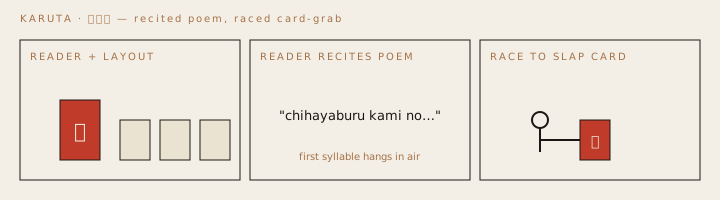
New Year's afternoon. The kotatsu table pushed aside, a hundred cards laid in three orderly rows on the tatami, and three cousins kneeling — seiza — around the edges, hands resting on their thighs, faces tilted slightly forward. The reader, an aunt this year, opens the lacquer box and takes out the first reading card. Her voice begins, slow and clear: "Aki no ta no kariho no io no toma o arami…" And before she finishes the first line, my older cousin's hand has already snapped down on a card across the tatami, and the room cracks with the slap of palm on paper.
How it was played
There are two main families of karuta. The most famous is Hyakunin Isshu Karuta — One Hundred People, One Poem Each — a competitive game built on a thirteenth-century anthology of one hundred classical Japanese waka poems. The other major family is Iroha Karuta, a children's game with proverbs.
In Hyakunin Isshu, each poem has two cards. The yomifuda — the reading card — has the entire 31-syllable poem on it, often with a tiny portrait of the poet. The torifuda — the grabbing card — has only the second half of the poem, in flowing hiragana, no portrait. The reader keeps all hundred yomifuda in a stack. The torifuda are spread out on the tatami in front of the players, face up.
The reader picks a yomifuda and reads the poem aloud — slowly, melodically, in a half-sung classical cadence called karuta-yomi. As she reads, the players scan the spread of torifuda searching for the second half of the poem she is reading. The first player to slap their hand on the correct torifuda keeps it. Whichever player has more cards at the end of the round wins.
The mastery of competitive karuta — kyogi karuta, the formal sport — is in the kimari-ji: the determining syllables. Many of the hundred poems begin with the same first one, two, or three syllables. A poem starting with "chi" could be one of seven different ones, and only by hearing more of the line can you know which. But the elite players — the ones who play in tournaments at the Omi Jingu shrine in Otsu every January — have memorised every kimari-ji. They know that "murasame no…" must be poem 87, because no other poem in the hundred starts with "mura". They slap the torifuda before the reader has finished the third syllable. The hand moves before the mind has finished translating.
The tatami layout had its own grammar. Each player chose 25 cards to place in front of themselves, in three rows. The middle row was the prized real estate; the back row was where you put cards you knew well. A snatch from the opponent's territory cost double — you took their card, and you also got to send one of your own back to them. The geometry of the spread was studied, planned, and re-planned over years.
The classical version was a New Year's tradition — the entire family playing together on the second or third of January, the elderly aunt or grandmother reading, the cousins competing, the youngest kid usually losing all their cards but cheered on anyway. In Iroha Karuta, the children's version, each card has a single proverb starting with one of the 47 iroha syllables — "i no ichi…", "ro wa ron…", and so on — the difficulty is much lower, the laughter much higher.
In Hokkaido there is a variant called Shimohan Karuta using wooden cards instead of paper, struck with a wooden ruler instead of a hand. In Okinawa the uta-sanshin version uses Okinawan poems set to sanshin music. In school karuta clubs across the country, kids practice three afternoons a week against the same hundred poems, and a determined high schooler can identify any poem from the first three syllables.
What it meant
Hyakunin Isshu Karuta is a thousand years of Japanese poetry compressed into a parlour game. The hundred poems were selected by the poet Fujiwara no Teika in 1235 from a span of six centuries of classical waka. To memorise them — even half-consciously, even for a game — is to inherit Heian-period court emotion: the autumn sleeve damp with dew, the bell at distant temple, the lover who did not come home, the moon visible through the broken window of a fisherman's hut. The Japanese teenager who wins regional karuta tournaments has ingested the emotional vocabulary of her own civilization without ever sitting in a literature class.
It also taught the strangest sort of physical discipline: hearing as athletics. A karuta champion's reaction time on a familiar opening syllable is faster than a Formula 1 driver's reaction to a starting light. The hand has been trained, over years, to move on a sound — not on a thought.
The cultural meaning of karuta deepened with the manga and anime Chihayafuru (2008-2022), which dramatised competitive karuta and pulled hundreds of thousands of teenagers into the sport. There are now active karuta clubs in Tokyo high schools, in Brazilian-Japanese diaspora communities in São Paulo, and — surprisingly — in Vancouver and Sydney where second-generation kids learn the hundred poems in the language they otherwise rarely use.
What is lost when karuta disappears is the New Year's afternoon. The whole-family-quiet. The hundred cards on the floor. The reader's slow voice. The grandmother who reads in a voice slightly different from anyone else, a voice that contains fifty Januaries.
How we'll bring it online
Top-down 3D tatami spread of torifuda cards arranged in rows. The reader's voice is a real, recorded voice — we are commissioning recordings of all hundred poems from a kyogi karuta certified reader in Otsu, with a second voice in older traditional cadence and a third in a more modern, school-club style. Players choose which voice to play with.
The grab is a tap. Latency is measured in milliseconds; we sync clocks across players to within 50ms so the contest is fair across continents. As the reader's voice begins, all players see the same spread; whoever taps the correct card first wins it.
Live three-to-five player matches over voice (banter and laughter is half the joy). Async mode is a single-player solo run against the clock — your time per round is logged and shared to a friend's leaderboard.
Cosmetic layer: card-art packs (classical Edo woodcut, Meiji ukiyo-e revival, modern Chihayafuru anime style), tatami surface variants (clean modern, weathered grandmother's house, temple courtyard), reader-voice packs as described. Phase 2 unlocks the Iroha Karuta children's variant for younger players and a Hokkaido Shimohan wooden-card variant.
What doesn't translate: the speed. A live tournament kyogi karuta match is faster than any phone touchscreen can register. Our digital version is therefore not the same sport. It is a learning version, a casual version, a version your American grandmother and your Tokyo cousin can both play.
Voices
(Pending. Voice memos to be recorded with native speakers from Tokyo / Otsu / São Paulo by Phase 1.)


