Menko
The thick card slapped against the tatami with a sound like a small drum — pan! — and the air it pushed across the floor flipped my opponent's card over. Both of us froze for half a second to see if it had really turned. Then the older boy laughed and scooped up the win, and I went home that evening with one fewer Ultraman in my deck.
How it was played
A menko is a thick rectangular card, printed on one side with a samurai or a baseball player or a kaiju monster, blank or paler on the back. It used to be made of clay — doro-menko — in the Edo period, then paper-laminated cardboard from the Meiji on, and the modern Showa-era ones from the 1950s and 60s are the most collectible: thick, slightly waxy, with vivid printed art that defined the visual childhood of two Japanese generations.
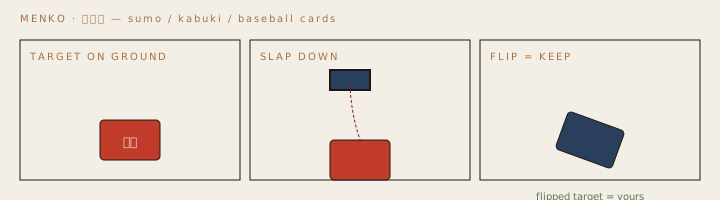
The basic rule is simple. Two players each lay one of their menko face-up on the ground. Players take turns slapping a third menko — the attack card — onto the tatami (or wooden floor, or hard packed earth in a temple courtyard) right next to the opponent's card. The slap creates a wind-rush and a mechanical thump. If your card-throw makes the opponent's card flip over from face-up to face-down, you win it. You take it home. It is yours.
That is the whole game. Two cards on the floor, alternating slaps, until somebody flips. The simplicity is deceptive.
The technique was everything. You learned to angle the card into the floor — not flat, but slightly tilted on the leading edge, so the slap pushed air under the opponent's card rather than just bouncing it. You learned to commit to the throw with your full shoulder; a half-hearted slap did nothing. You learned to read the opponent's card — heavier ones flipped less easily, lighter ones flipped at a breath, but lighter ones also wore out their corners faster and lost their snap. Some boys put a small bend at the centre of their attack card so it hit the floor harder. Some folded the corners up in a tiny triangle to catch more wind.
There were variants. Okimenko used a square card and the win condition was to push the opponent's card outside a chalked circle on the floor. Kakemenko — the betting version — let players agree on stakes (two cards to win, three to win) before each slap. Mawashimenko used a spinning, top-like menko that you spun flat on the ground and tried to make rotate longer than your opponent's. The classic urban game in 1960s Tokyo was the simple flip-and-take, played on the tatami of any house with a kotatsu table pushed aside.
The cards were currency. A boy's menko deck was his net worth. A really good champion-level menko — laminated thick, with the perfect bend, art still glossy — could be traded for ten lesser ones, or for a handful of Glico caramels. Losing your prized Ultraman menko to a kid two years older was a wound that stayed with you for weeks. Winning it back the following Saturday was redemption.
The game stopped at dinnertime. Mothers shouted "gohan!" — rice — through the fusuma doors, and the boys would scoop up their cards into a small wooden box, count them carefully, and run home with them clutched against the chest.
What it meant
Menko is the Japanese childhood currency game. Every Japanese man between 55 and 80 has played it; every Japanese man under 40 has only heard of it. The game ran continuously from about 1700 (when the Edo doro-menko used clay tokens) to around 1985 (when video games and trading-card games — Bikkuriman, then Pokemon, then Yu-Gi-Oh! — replaced the floor-slap with a card-shop economy).
It taught two things: physics and ownership. Physics, because every menko throw was a small experiment in air-pressure and angular impact. Ownership, because every match had real stakes — your card or theirs — and the consequences of a bad throw were felt all the way home. The trading-card games of the 1990s inherited the ownership half of the game and lost the physics half; this is why a fifty-five-year-old grandfather, watching his grandson buy booster packs, sometimes mutters that the games today are "all chance, no skill."
Cousin games exist in Korea (Ddakji, also a slap-flip card game, and the better-known one outside East Asia thanks to Squid Game) and in China (Pog-style flip games of the 1990s, themselves a Western import). The Korean Ddakji uses folded paper rather than printed card, and the slap dynamics differ — but the core mechanic, the aerodynamic flip, is the same idea, and the two games are siblings.
What's lost when Menko disappears is the physical card economy. Children today collect, but they collect digital tokens with no weight, no smell, no corner-wear. The thick waxy feel of a 1960s menko — the printed gloss of a Showa baseball player — these have become museum objects. There are vintage menko shops in Asakusa and Akihabara now, selling the same cards that used to slap against tatami for a few yen, now priced at thousands.
How we'll bring it online
A side-and-top hybrid view of a wooden floor. The slap is a flick gesture — drag your card down toward the floor, release at peak speed for maximum impact. The physics engine models card-edge angle, surface friction, and the air-pocket that lifts the opponent's card. We tuned the haptic to deliver a sharp short tap on impact — the closest a phone can get to that pan! sound.
Live two-player matches over voice. Async match: a turn = one slap; you take yours, the opponent watches it as a slow-motion replay, then takes theirs. The deck of cards each player owns is real — collected from match wins, traded between players, or earned via daily challenges. We are deliberately keeping the trading economy small-stakes; this is not gacha.
Cosmetic layer: card-art packs by era (Edo doro style with samurai woodcuts, Meiji photo-print, Showa baseball, Showa kaiju, Heisei modern abstract) and floor-surfaces (tatami, polished pine, packed temple-courtyard earth). The Ultraman card is a Phase-2 licensed unlock if we secure rights. Voice-line packs include the gohan! call from inside the house.
What doesn't translate: the tatami. The sound a menko makes on a 1960s tatami floor — that specific dry papery thud — cannot be reproduced through a phone speaker. We do our best with curated audio samples from a real Tokyo tea-house floor.
Voices
(Pending. Voice memos to be recorded with native speakers from Tokyo / Osaka / Sapporo by Phase 1.)


