Bao
A wooden board carved from a single piece of mvule hardwood, two long rows of sixteen pits scooped into it, the wood polished smooth by sixty years of palms. My grandfather sits cross-legged on the baraza — the raised stone bench outside the house in Lamu — and the fishermen passing on their way to the dhow harbour stop to watch him play. He scoops eight tiny kete seeds from a pit and sows them around the board in a swift counter-clockwise arc. "Mtaji!" he says quietly. The capture has begun.
How it was played
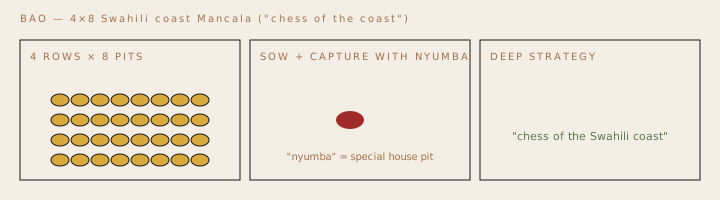
Bao la kiswahili — the Swahili Bao — is the most strategically deep of the Mancala-family games, played most seriously along the Swahili coast (Kenya, Tanzania, Comoros) and into the African Great Lakes region. The board has 32 pits arranged in two rows of sixteen on each side — the player's home row (the row closer to them) and their back row (the row further). Each player controls 16 pits.
The pieces — kete (seeds, traditionally hard tropical seeds, sometimes pebbles, sometimes the polished beans of the mvule tree) — number 64 in total. They are distributed across the board at the start of the game in specific configurations: typically two seeds in each of the four central back-row pits and four seeds in two of the front-row pits, with the rest held in reserve.
The aim is to capture all of the opponent's seeds, or to leave them with no possible move.
A turn consists of sowing — picking up all the seeds from one of your pits and dropping them, one by one, into the next pits along the row in a counter-clockwise direction. (Some variants permit clockwise as well; Bao la kiswahili is strict counter-clockwise on most moves but allows clockwise in specific opening conditions.)
The capture mechanic is what makes Bao so rich. If your final sown seed lands in a pit on your home row that contains seeds, and the opposite pit on the opponent's home row also contains seeds, you capture — you take all the seeds from the opponent's opposite pit. You then immediately re-sow those captured seeds: starting from the pit they came from, you sow them counter-clockwise around the board, and if your re-sowing produces another capture, you re-sow again, and so on. A skilled player can chain four or five captures in a single turn — the mtaji (tax) — and demolish an opponent's position in one move.
There is an opening phase — namua — where players each turn add a single seed from their reserve into a chosen home pit, building up the position. Once both reserves are exhausted, the game enters the mtaji phase, where pieces are moved freely from the board. In the mtaji phase, the chains of capture become decisive.
The strategic depth is staggering. Bao la kiswahili has been compared to chess and Go in its tactical complexity; computer programs have only recently begun to play at master level. Top players in Zanzibar, Mombasa, and Dar-es-Salaam can plan eight or ten moves ahead. The annual Bao championship in Zanzibar — held since the 1960s — draws masters from across East Africa, and the games are public spectacles, with hundreds of fishermen, traders, and elders watching in respectful silence.
The board itself is sculpture. The finest Bao boards are carved from a single block of mvule, mninga, or ebony hardwood, with the pits worn smooth from generations of fingers. Comorian boards often have ornamental carvings around the edges. The Mombasa style has pits of slightly different depths in the home and back rows, an aesthetic touch with no game-mechanical effect. A grandfather's Bao board is an heirloom; it passes down on his death like a finely tuned instrument.
The pace of play is contemplative. A serious Bao match between masters can run two hours, with several minutes between moves while the players read the board. The baraza — the stone bench — is the traditional seat. Two players, board between them, the warm Indian Ocean breeze, the call to prayer drifting from the mosque, the slow click of kete seeds being moved.
Variants. Bao la kiswahili is the Coastal version — most strategic. Bao la kujifunza — Bao for learning — is the simplified rule-set used to teach children. Hawalada in Uganda, Omweso in Buganda, Igisoro in Rwanda — all are sibling games in the broader Mancala family. In Madagascar the cousin game is Fanorona (which is technically a different family, but often grouped). In the Comoros the Mraha wa Tatu is closer to Bao la kiswahili with minor pit-count differences.
What it meant
Bao is the Swahili coastal game. It rode the dhow-trading routes of the Indian Ocean — Lamu to Zanzibar to the Comoros to Madagascar — and shaped the leisure culture of generations of merchant families. The baraza — the stone bench outside Swahili stone-houses — was traditionally the men's social space; Bao was the social activity that anchored that space. To watch Bao on a Lamu baraza in the late afternoon is to watch a centuries-old practice continuing without significant interruption.
It is, more broadly, the highest-strategy of the Mancala games — a continent-wide family of sow-and-capture games that exist in some form in nearly every African culture. The simpler Mancala games (children's Awari in Ghana, two-row Oware, the four-row Omweso in Uganda) are widely played; Bao la kiswahili is the most demanding, the most prestigious. Mastery requires years.
What it taught: deep planning, pattern recognition, the willingness to think in long arcs of cause-and-consequence. A child who has played Bao with a grandfather for ten years has a particular cognitive shape — patient, layered, anticipatory — that shows up in school exam performance, in adult negotiation, in chess.
The cousin games span the continent. Awari, Oware, Wari, Warri, Ayo, Songo, Pallanguzhi (the South Indian variant — yes, the Mancala family even crossed the Indian Ocean to Tamil Nadu), Sungka in the Philippines (carried by Indian Ocean trade routes). The fundamental sow-and-capture mechanic is one of humanity's most widespread game-design ideas. Bao la kiswahili is among the most refined.
What is lost when Bao fades: the baraza. The intergenerational male public space, the slow-afternoon strategic conversation between elders, the watching of master play as a form of cultural transmission. Modern Mombasa and Zanzibar still have Bao but the urbanisation pressure thins it. The grandfathers play. The grandsons sometimes watch.
How we'll bring it online
3D wooden board with high-fidelity hardwood texture (selectable as mvule, mninga, ebony, or modern stained pine). The pits are deep and shadowed; the kete seeds are small and individually rendered. Sowing is a touch-and-drag — pick up all seeds from a pit, watch them sow around the board in a satisfying counter-clockwise spray. Captures animate with a clear visual and audio cue.
Live two-player matches over voice — though Bao is one of the few games where silence is part of the play, and a quiet voice room with occasional commentary is the norm. Async mode is essential and natural for Bao: a turn a day, like the late-period Bao-by-mail games among the East African diaspora in the 20th century.
We support both rule-sets — Bao la kiswahili (full strategic) and Bao la kujifunza (learning) — and a tutorial mode that walks through namua-phase openings and mtaji-phase capture chains.
The strategic depth deserves, and gets, a robust AI. We are training a Bao engine using self-play (modelled after AlphaZero's approach) so that the solo-mode opponent is genuinely challenging and can play at a recognisable master level for higher difficulties.
Cosmetic layer: board materials (mvule, mninga, ebony, modern lacquer), seed types (Swahili kete, Comorian shells, Ugandan beans, Rwandan stones), table settings (Lamu baraza sunset, Mombasa harbour view, Zanzibar courtyard, Dar-es-Salaam modern living room). Voice-pack: the call to prayer drifting in, the dhow harbour sounds, Swahili commentary in classical and modern dialects, the satisfied "mtaji" of an elder who has just chained a four-capture.
What doesn't translate: the baraza. The warm stone, the breeze off the Indian Ocean, the smell of kahawa — strong Swahili coffee — being prepared just inside the doorway. The board is portable; the baraza is not.
Voices
(Pending. Voice memos to be recorded with native speakers from Lamu / Zanzibar / Mombasa / Dar-es-Salaam by Phase 1.)


