Ddakji
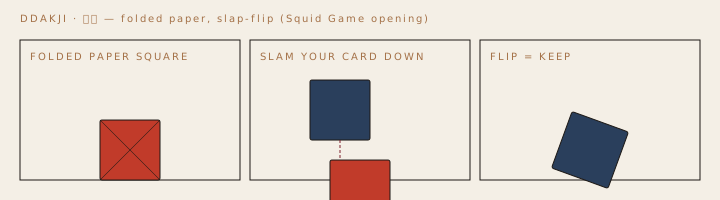
A folded paper square the size of my palm. Two pieces of newspaper — sometimes a torn poster from the cinema across the alley, sometimes an old textbook page my older brother had finished with. Folded into eight crisp triangles, locked together at the centre. You held it carefully because a sloppy fold lost a ddakji before it had ever been thrown.
How it was played
You made the ddakji yourself, and the making was half the game. Two square pieces of paper — newspaper, magazine, school-notebook — folded into long thin strips, then folded again into a square with eight triangular flaps. The two squares were interlocked so the flaps wove together at the centre and the whole thing held its shape under impact. The thicker the paper, the stronger the ddakji. The harder the folds, the longer it lasted.
Two players each placed one ddakji face-up on the ground. The defender's ddakji sat on the dirt, pavement, or cement floor of an alley. The attacker held their own ddakji in their hand, raised it overhead, and slammed it down next to the defender's. The wind-rush and the impact had to flip the defender's ddakji from face-up to face-down. If it flipped, the attacker took it. If it didn't, the attacker's ddakji stayed on the ground as the new defender, and the previous defender now took the attack role.
The technique mattered enormously. You aimed the corner of your ddakji into the ground beside the opponent's, not flat — the corner concentrated impact and pushed air under the edge of their card. You committed your shoulder. You exhaled on the slam — the breath was discipline, the breath was timing. You learned which side of your ddakji hit harder; the side that had been pressed down longer in your pocket was tighter, denser, and travelled with less drag. A worn-corner ddakji was useless because the air slipped through.
The defending ddakji was placed strategically. Some boys placed it flat in the centre of a clear patch of floor — the most "fair" placement. Others tucked it close to a wall, where the attack had to hit at an angle, harder to flip. Others wedged a corner under a small stone so the leading edge sat slightly raised — a "lifted" defence that caught the wind better. There were unwritten rules about how much the defender could "set up" their card; abuse it and the other boy refused to play.
The Korean alley Ddakji of the 1970s and 80s was a public-space economy. Boys carried wads of ddakji in their school satchels — sometimes thirty, fifty pieces — and a famous ddakji champion in our neighbourhood (his name was Min-jun, fourth grade, faster hands than any of us) had a hundred and twenty ddakji in a shoebox under his bed by the end of one summer. Walking past Min-jun's house with a ddakji in your hand was like wearing your wallet on the outside.
There were variants. Ddakji-Chigi was the standard slap-and-flip. Bbang-Ddakji used printed paper ddakji sold at the munbangu — stationery shop — with cartoon characters on them; these were considered slightly cheap by purists but were prized by younger kids. Geum-Ddakji — gold ddakji — were special heavy ones made from cardboard, allowed only in advanced matches because they would damage a regular paper ddakji on contact.
The end-of-day ritual was emptying your pockets onto the bedroom floor and counting the day's score. A net gain of three ddakji was a good day. A net loss of five was a bad day. A loss of your "champion" — the ddakji you had folded most carefully, with the tightest centre, and decorated with a coloured pen — was the kind of loss that made you stop talking on the walk home.
What it meant
Ddakji is the Korean childhood currency game. It ran from at least the early 20th century — earlier folk versions exist — through the 1980s as a daily after-school activity. It is the cousin to Japanese Menko; the two games share the slap-and-flip mechanic and the air-pocket physics. The Korean version differs in two important ways: the ddakji is folded paper, not printed cardboard, and the ddakji is made by the player rather than purchased. This made Ddakji a more democratic game — every kid could make one from any newspaper, no shop required.
It taught manual dexterity, paper-engineering, and a kind of quiet discipline. The boy who could fold a clean tight ddakji in three minutes was the boy who could later assemble a model airplane, repair a radio, write neat hanja. The fingers learned a vocabulary that transferred to every adult task that required precision.
It also taught economy. Children learned to manage a portfolio of ddakji — to play their weakest ones first, save their champion for the most contested match, trade up when they could, lose gracefully when they couldn't. The cards were real assets in a real children's market.
The international audience now knows Ddakji because of Squid Game (2021), which opens with an unforgettable scene: a stranger in a suit invites a stranger in a tracksuit to play Ddakji in a Seoul subway station. The slap, the flip, the win, the slap to the face for losing — the world watched and many people thought it was a fictional game invented for the show. It is not. It is the game my grandfather played, and his grandfather played, and which Min-jun won so much of in 1986.
What's lost: the folding. Korean kids today buy ddakji in plastic packs at convenience stores when they buy them at all, and the folded paper version is now mostly a museum exhibit. The skill of making a ddakji — the four crisp folds, the interlock, the press of your thumb on the centre — has thinned to the elder generation.
How we'll bring it online
A side-and-top hybrid view of an alley floor. The slap is a flick gesture downward. Air-physics modelling: angle of attack, corner-edge impact, surface friction. The opponent's ddakji responds with a satisfying flip animation if you've hit it right. The haptic snap is tuned to feel like real paper-on-cement.
Live two-player and four-player tournament modes. Async: turn-based, with each slap a recorded animation reviewed by the opponent before their response. The asynchronous version of Ddakji recreates the long, slow back-and-forth of an after-school game extended into a working week.
A defining feature: you fold your own ddakji. We built a paper-folding mini-game where you take a chosen sheet (newspaper, poster, textbook page), perform the eight folds via gesture taps, and the resulting ddakji has stat values — weight, corner-tightness, air-resistance — derived from how cleanly you folded. Your folded ddakji is your character.
Cosmetic layer: paper packs (Seoul newspaper 1985, Pyongyang state poster, modern K-pop magazine, vintage textbook), surface packs (alley dirt, school cement, hardwood floor), folded-pattern packs (champion's tight-centre, geum gold-cardboard). Voice-line packs with the alley sounds — the school bell in the distance, a mother calling bap meogja across the alley, the tight-jaw exhale of a hard slam.
What doesn't translate: the slap on the face. We will not include the loser's-forfeit slap from Squid Game. It was dramatic for television; it is not how kids actually played.
Voices
(Pending. Voice memos to be recorded with native speakers from Seoul / Busan / LA Koreatown by Phase 1.)


