Yutnori
The four wooden sticks rattle once in cupped hands and the thrower flings them up so high they almost touch the ceiling beam. They tumble, they clatter on the maru floor, and the whole room — three generations of an extended family on Lunar New Year afternoon — leans forward to count which sides landed face-up. "Yut!" my uncle yells. Four flat sides up. Everyone groans, because his team is now four spaces ahead, and we will probably lose this round.
How it was played
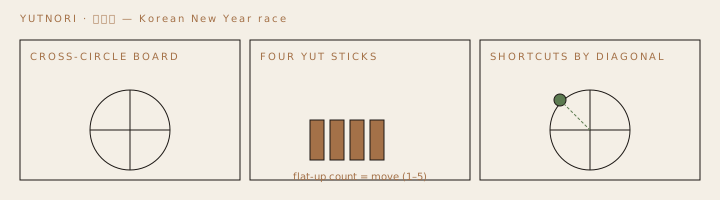
Four wooden sticks, each about the length of a child's palm, flat on one side and curved on the other. They are the dice of Yutnori, but they are dice with a history older than dice. Each stick lands either flat-side-up or curved-side-up. The combinations of four sticks produce five named outcomes:
Do — one flat, three curved — move 1 space. Gae — two flat, two curved — move 2 spaces. Geol — three flat, one curved — move 3 spaces. Yut — all four flat — move 4 spaces, throw again. Mo — all four curved — move 5 spaces, throw again.
The names come from the old livestock-numbering system: Do for pig, Gae for dog, Geol for sheep, Yut for ox, Mo for horse. The bigger the animal in the agricultural economy, the bigger the move on the board. The farmer's hierarchy literally became the throwing values of the game.
The board is a square track of 29 stations — typically drawn on cloth, paper, or carved into a wooden block. Each team has four tokens (called mal — horses) that must enter the track at one corner, travel around the perimeter, and exit at the same corner, completing the full circuit. There are diagonal shortcut paths cutting across the centre of the board: if your mal lands exactly on a corner station, it can choose to take the diagonal shortcut on its next move, dramatically reducing the distance home.
Two teams played, with anywhere from one to four players each. You took turns throwing the sticks — sometimes alternating, sometimes letting one teammate become the designated thrower (the gosu — the master) — and moving any of your team's mal. You could move different mal on different throws, splitting your forward progress.
The two key strategic moves: capture and stack. If your mal landed on the same station as an opponent's mal, the opponent's was sent back to the start, and you got an extra throw. If your mal landed on the same station as your own mal, the two could stack into a single combined token that moved together — twice the value to capture, but if captured, both went back to the start. Three-stacks and four-stacks were possible. A captured triple-stack was a catastrophe that swung whole games.
The throw itself was the visible joy. The yut sticks were thrown high and dramatic — straight up over the head, with full-arm extension — so that the air rushing past their carved surfaces produced a satisfying whirring sound on the way up. The clatter on landing was the family's collective heartbeat. Old men threw with a slow ceremonious arc; small children threw too low and were laughed at; the women threw with calm mechanical accuracy and won every Lunar New Year.
Variants: in some northern regions a fifth value, Ddo — a special outcome for specific stick configurations — gave a six-space move. In some households the four sticks were replaced by three (a smaller version, yutnori of three) for shorter games. In Jeju the sticks were shorter and the board carved smaller. In the diaspora Korean American versions of the 1990s, plastic sticks replaced wooden ones and the cloth board was replaced by a printed cardboard one sold at H-Mart.
What it meant
Yutnori is the centre of Korean New Year. Seollal — the Lunar New Year — is when the entire extended family gathers at the eldest's home, performs the ancestral charye ritual, eats tteokguk rice-cake soup, and then plays Yutnori until late evening. The board is set up on the maru floor; the sticks are passed around; the laughter is the laughter of three generations who otherwise speak across silent dinners during the working year.
The game is older than written Korean history. It was played in the Gojoseon period, more than two thousand years ago, in agricultural celebration calendars. It was played by Goryeo-era courtiers and Joseon-era farm households. It survived Japanese colonial-era cultural suppression because it could be played quietly indoors with sticks anyone could carve. It survived the Korean War because the board could be drawn on any flat surface — the dirt of a refugee camp included. It survived the rapid urbanisation of the 1970s because it folded compactly and travelled in luggage.
The game shares a deep family relationship with other stick-and-track games across Asia: Pachisi in India (the ancestor of Western Ludo), Tao in Mongolia, Halatafl in old Scandinavia. They all share the use of randomised throws to move tokens around a perimeter track with shortcut paths. Yutnori's distinctive feature is the four-stick throwing mechanic and the agricultural-livestock naming system.
What it taught: probability and patience. Children learned, by repeated experience, that Yut and Mo were rarer than Gae — without ever doing the math — and they learned to plan their moves accordingly. Adults played to lose to children at the start of the night, then played to teach as the night progressed.
What's lost when Yutnori fades: the Seollal afternoon. Younger generations of urban Koreans now skip the family gathering or shorten it to a meal. The board comes out less. The sticks gather dust in a closet with the rest of the inherited objects.
How we'll bring it online
Top-down 3D board with the familiar 29-station perimeter track and four diagonal shortcuts. The throw is a satisfying gesture: pinch-and-toss the four sticks upward on the screen, watch them tumble in physically simulated air, and read the result as they land. We tuned the stick physics for realistic chaos — no two throws look alike — but we capped the bounce so the result reads quickly.
Live two-team matches over voice — and Yutnori is famously a voice-room game. The cheering, the groaning, the strategic suggestion-shouting between teammates — these are not optional. Async mode: each throw is a turn, the result and the chosen mal movement are pushed to teammates and opponents, and games can stretch over a workday or a week. Excellent for diaspora families across time zones.
Cosmetic layer: stick-wood packs (paulownia traditional, oak modern, Jeju black-pine, palace-style lacquered red), board surfaces (cloth from Andong, paper from Insadong, modern printed, ancestor-painting style), token shapes (classical mal horses, abstract modern, child-friendly cartoon). Voice packs include the Seollal family ambient — the tteokguk simmering in the background, the grandmother shouting Yut! from across the room, the kids' laughter when a stack gets captured.
What doesn't translate: the charye and the tteokguk. The game is embedded in a holiday and a meal. We can put a board in a phone but we cannot put the bowl of soup next to it. Diaspora families can play remotely on Seollal itself, and they often do, soup at one end of the call, soup at the other.
Voices
(Pending. Voice memos to be recorded with native speakers from Seoul / Andong / LA Koreatown by Phase 1.)


