Whot
The cards slap on a folding plastic table in a Lagos courtyard, the generator humming at the gate, the NEPA having taken light again at 6pm just like every other evening. Four cousins on plastic chairs, the suya smoke drifting in from the next compound, and somebody — usually the youngest cousin who fancies himself the loudest — banging the whot 20 down on the table and yelling "Pick three! Pick three for you!" before the previous player's card has even settled.
How it was played
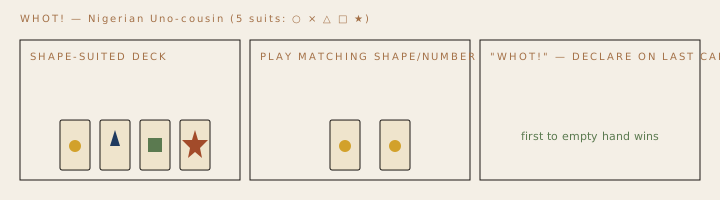
A Whot! deck is fifty-four cards across five suits — Circles (red), Triangles (green), Crosses (blue), Squares (yellow), and Stars (purple) — plus five special Whot cards numbered 20. Each suit runs from 1 to 14 (in the standard deck, with some cards skipped — typically no 6s, 9s, or 11s in the Circles, no 6s and 9s in the Triangles, etc., creating an asymmetric distribution that is itself part of the strategy). Total 54 cards.
The aim is to be the first player to shed — discard all your cards. Each player is dealt four to six cards depending on the agreed game format. The remaining cards form the market (the draw pile, face-down) with the top card flipped face-up to start the call card.
On your turn, you play a card that matches either the suit or the number of the call card. So if the call is a Triangle 7, you play any Triangle, or any 7 of any suit, or a Whot 20. If you cannot match, you draw from the market — sometimes one card, sometimes more, depending on the variant — and your turn ends.
The special cards make Whot! unmistakably itself:
1 (Hold On) — Play a 1 and the next player must skip their turn.
2 (Pick Two) — Play a 2 and the next player must draw two cards from the market and skip their turn — unless they can play another 2, in which case the count doubles and stacks (4, 6, 8) until somebody can't respond.
5 (Pick Three) — Same mechanic as Pick Two but stacks at 3, 6, 9. Brutal.
8 (Suspension) — Skip the next player's turn entirely.
14 (General Market) — Every other player must draw one card from the market.
20 (Whot) — The wildcard. Play a 20 from any colour, then declare which suit you are switching the call to. The 20 is the king-maker of the game.
The endgame has a specific ritual. When you are down to one card, you must announce "Last card!" before playing it. If you forget and somebody else notices, you must draw two cards as penalty. If you say "Last card!" but a stacking-card cycle prevents you from playing on your next turn, you must say "Check up!" on your follow-up turn to confirm you still have one card. The verbal layer is essential. Whot! without trash-talk is Whot! without flavour.
There are house rules everywhere. In the most common Lagos rule-set the 14 (General Market) is mandatory — opponents draw whether they want to or not. In some Calabar variants the General Market only triggers if the player calling it has already drawn at least once that round. In Onitsha the suspension card 8 stacks — multiple 8s skip multiple turns. In the Ghanaian variant the 5 (Pick Three) is replaced with a Pick Five — even more punishing.
The Nigerian Whot deck is a distinctive cultural object. Salin Industries Ltd (now Nigeria Playing Cards) has been printing the iconic deck since the 1960s, with the same five-shape suits and the same vivid colour palette. Almost every Nigerian household has at least one well-worn deck somewhere in a drawer. The cards are stamped with "Whot!" in bold red on the back and have been the same design for two generations.
The game is mostly an evening game. The NEPA takes light at six. The generator is too loud to talk over. Out comes the deck. Whot! fills the gap until the lights come back, or until somebody serves dinner, whichever is first.
What it meant
Whot! is, surprisingly, a relatively recent invention — designed in the United Kingdom in the 1930s by a man named W.H. Storey (the whot in Whot! is a play on his name) as a children's card game. It travelled to Nigeria in the colonial period and was rapidly absorbed and indigenised. Today the global identity of Whot! is overwhelmingly Nigerian; if you say "Whot" in most of the world, the card game evoked is the Nigerian one. Salin Industries' deck design has become the canonical version.
The game taught two things. First, anticipation: a good Whot! player tracks every card played, calculates which suits and numbers remain in the market, and plays toward an endgame three turns in advance. Second, vocabulary as weapon: the trash-talk culture of Nigerian Whot! is bilingual (Pidgin English and the regional language) and continuous. "Pick three for you!" — "Last card o!" — "Check up!" — "Soak yourself!" (when you've drawn a heavy stack).
In Nigeria the game is intergenerational. Grandfathers play with grandchildren. Office colleagues play during lunch breaks. Boarding-school students play after lights-out. Whot! tournaments run in Lagos clubs and in church social halls. It is one of the few games that crosses Nigerian class lines almost completely.
The cousin games are the entire global Crazy Eights family — Uno (most famously), Mau-Mau in Germany, Switch in the UK, Pesten in the Netherlands, Nai Sabai in Thailand. These are all variations of the same shed-and-call mechanic with special cards. Whot! differs in three ways: the five-suit deck (most others use four), the 20 wildcard mechanic (cleaner than Uno's wild), and the verbal penalty layer ("Last card!", "Check up!").
What is lost when Whot! fades — and it is not fading, it is one of the more vibrant traditional games in Nigerian life — would be the verbal layer. The trash-talk, the Pidgin commentary, the NEPA-took-light evening rhythm. Whot! without the chorus of cousins yelling at each other across a generator-lit courtyard is just a card game.
How we'll bring it online
3D plastic-table view, four players visible from a slight tilt-down angle. Cards in your hand are private; the call card and the market are shared. The trash-talk layer is built into the UI: tap-and-hold a special card to trigger a voice line — "Pick three for you!" — that plays for all opponents at slamming volume. The vocal commentary is recorded by Nigerian voice actors in five regional accents (Lagos Yoruba, Igbo, Hausa, Calabar, Pidgin general).
Live four-to-six player matches over voice. The game is fast enough that voice is essentially mandatory; the trash-talk is structurally part of Whot!. Async mode: turn-based, but the trash-talk records as voice-clips that play when the next player opens their phone, which preserves about 70% of the experience.
We support all major variants — Lagos standard, Onitsha stacking-suspension, Calabar conditional general-market, Ghanaian Pick-Five — selectable at table creation.
Cosmetic layer: card-back designs (classic Salin red-on-white, modern remix, regional artist editions, Yoruba-Adire-pattern), table surfaces (folding plastic, mahogany sitting-room, courtyard cement), generator-and-NEPA ambient loops, market-pile designs. The voice-line packs in five Nigerian dialects are unlocked individually.
What doesn't translate: the generator. The hum of a Mikano generator at the compound gate is the bassline of evening Nigerian life; we can play it through phone speakers but the windows of an apartment in Atlanta do not vibrate the same way they do in Lagos.
Voices
(Pending. Voice memos to be recorded with native speakers from Lagos / Onitsha / Accra / Houston Nigerian community by Phase 1.)


