Mū Tōrere
A board scratched into a flat stone outside a whare — house — in the Whakatāne district of the Bay of Plenty, the Whakaari volcano steaming faintly out at sea. My koroua — grandfather — and his cousin sit on flax mats in front of the board, eight points radiating from a central hub like the spokes of a wheel. They use small kōhatu — pebbles — four black for him, four white for the cousin. He slides one piece. The cousin breathes in slowly. The piece has cut off three of his options at once.
How it was played
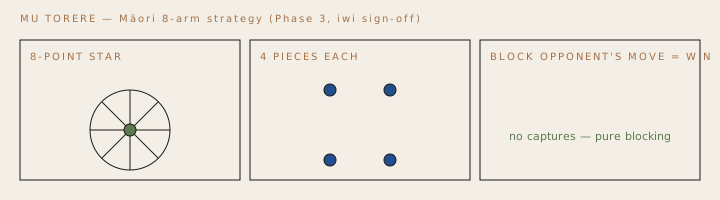
Mū Tōrere is the only known indigenous Māori board game with documented continuous play. The board has nine positions: eight outer points arranged in a circle, plus one central point in the middle, with lines connecting each outer point to its two neighbours and also to the central hub.
Each player has four pieces — kaipupuri. Black and white traditionally; sometimes light and dark stones, sometimes shells, sometimes wood. The starting position has all four black pieces on consecutive outer points (positions 1, 2, 3, 4 of the eight, going clockwise) and all four white pieces on the opposite four consecutive outer points (5, 6, 7, 8). The central point is empty at start.
The aim: trap your opponent so that they cannot make a legal move on their turn. The trapped player loses. There is no other win condition — no points, no captures, no time limit. The game is purely about achieving zugzwang on the opponent.
Movement. On your turn, you slide one of your pieces along a line to an empty adjacent point. You cannot jump pieces. You cannot capture pieces. The constraint that makes the game subtle is the first move rule: on your very first move (the opening), you can only move one of your two end pieces — the pieces at the boundary between your colour's territory and the opponent's. You cannot move a middle piece on the first move.
After the opening, all subsequent moves are unrestricted: any of your pieces can slide to any empty adjacent point.
The strategic depth lies in the relationship between the eight outer points and the one central point. The central point is connected to all eight outer points; controlling the centre is a powerful position. But putting your piece in the centre exposes you to forced responses. The skilled player times the centre-occupation with surgical precision.
The game is short — a Mū Tōrere match between average players runs ten to fifteen minutes; between experts, perhaps thirty as the strategic depth manifests. The pace is contemplative. The board is small enough that it can be set up on a stone, a flat piece of wood, or — in modern revivals — a printed cardboard sheet from the Te Papa museum gift shop.
The historical setting is intimate. Mū Tōrere was played in the whare — the Māori meeting-house — between elders, and at home between family members. It was sometimes used as a teaching game for children to develop strategic thinking. Documented descriptions from 19th-century European-Māori contact recorded the game as already being played widely across iwi (tribes) of the North Island, particularly in Te Tai Rāwhiti (the East Coast) and Te Whanganui-a-Tara (Wellington).
There is no widely standardised variant tradition — Mū Tōrere is one of the few board games that appears to have a single canonical rule-set with only minor regional variations in opening conventions. The game has been studied mathematically; computer analysis (most thoroughly by mathematician Barbara Reece in the 1980s and updated by subsequent researchers) has shown that with optimal play from both sides, the second player wins. The first player, in optimal play, is doomed by the asymmetry of the opening rule; this is part of the elegance of the game.
What it meant
Mū Tōrere is a piece of Māori intellectual heritage. While many indigenous cultures had board games (Senet in Egypt, Pachisi in India, Patolli in Mesoamerica), and while the Polynesian region has documentary evidence of various games (Konane in Hawai'i, Mu in Tonga), Mū Tōrere is the most documented and most strategically refined of the Māori board games surviving into the modern era. Its existence as an indigenous-Māori-developed strategic abstract game is, for some Māori scholars, a deliberate counterpoint to the colonial assumption that strategic abstract games are a European or Asian phenomenon.
The indigenous sensitivity flag is essential. Mū Tōrere belongs to Māori cultural inheritance, and our digital adaptation should be developed in consultation with Māori cultural authorities — iwi representatives, te reo Māori speakers, indigenous-game researchers. We will not ship Mū Tōrere in Khel without sign-off from a Māori cultural editor and at least two iwi-represented native-speaker reviewers. This is non-negotiable.
What the game taught — teaches — is positional thinking. The eight-outer-points-and-one-centre topology is unusual and forces the player to think about connectivity rather than mere distance. A piece at point 1 is adjacent to points 2 and 8 (its outer neighbours) and to the central hub. A piece at the centre is adjacent to all eight outer points. The graph-theoretic structure is what makes the game subtle, and the player who internalises this graph thinks more clearly about other strategic situations too.
The game has been included in some New Zealand primary-school curricula as part of te reo Māori and Māori-cultural education programs. The mathematical-research community in New Zealand has studied it extensively, partly because it is relatively simple and analyzable, partly as a deliberate effort to give Mū Tōrere the intellectual recognition it has historically lacked.
The cousin games are the wider Polynesian and Pacific abstract-strategy game family — Konane in Hawai'i (a checkers-style jumping-and-capturing game), Mu in Tonga (a similar sliding-and-trapping game with related topology). Globally, Mū Tōrere is in the family of trap-and-zugzwang abstract games, related at a high level to certain endgame positions in Chess and Go but distinctive in its small-graph topology.
What is lost when Mū Tōrere fades — and it has been fading and is being deliberately revived — would be the whare-side teaching. The grandfather-grandchild board at sunset. The slow positional reading of a board with only four pieces a side. Modern revival efforts (the Te Papa museum, university curricula, primary-school reintroductions) are working against decades of attrition.
How we'll bring it online
A 3D board view with the eight-outer-and-one-central topology rendered cleanly. Pieces are designed as kōhatu (smooth river-pebbles) in dark and light stone, with optional cosmetic skins as carved tā moko-patterned tokens (developed in consultation with Māori cultural advisors). The board itself can be styled as a flat stone (traditional), a carved wooden board (mid-20th-century), or a printed museum-style modern board.
Movement is touch-and-drag: tap one of your pieces, drag along a connection-line to an empty adjacent point. The line graph is highlighted on touch so beginners can see legal moves. We provide a tutorial mode with annotated openings and a beginner AI; the standard AI plays the proven optimal strategy that wins for the second player.
Live two-player matches with optional voice. The voice room is appropriate but not essential — Mū Tōrere is a contemplative game where silence is part of the play. Async mode is excellent: a turn a day fits the rhythm.
The cultural-context layer is heavy and careful. The game's UI presents te reo Māori terminology where appropriate (kaipupuri for piece, whare for the home base, etc.) with optional English translation. Tutorial content includes brief, respectful background on the game's origin and the iwi traditions associated with it, developed in consultation with Māori cultural authorities. We do not gamify the indigenous-cultural framing; we present it as historical and ongoing context.
Cosmetic layer (subject to Māori cultural-authority sign-off): board surfaces (traditional flat stone, carved wood, modern printed), piece designs (kōhatu river-pebbles, traditional shells, modern-Māori-artist editions). Voice-pack (subject to sign-off): coastal Aotearoa ambient — sea, tūī birds in kōwhai trees — with brief karakia-style spoken-word introductions in te reo Māori recorded by iwi-affiliated speakers.
We will not commercialise Mū Tōrere heavily. Cosmetic revenue from this game (if any) is committed in writing to flow back to Māori cultural-preservation organisations selected in consultation with our cultural editor. This is a model we want to extend across all our indigenous-flagged games.
What doesn't translate: the whare. The flax mat. The volcano in the distance. The grandfather's slow voice as he explains the trap that has just closed. We can render the board cleanly; the whakapapa — the genealogical-cultural inheritance that surrounds the game — is the work of the Māori cultural editor, not the digital adaptation.
Voices
(Pending. Voice memos to be recorded with native Māori speakers from Whakatāne / Tairāwhiti / Wellington / Auckland by Phase 1, with iwi cultural-authority sign-off mandatory.)


