Kubb
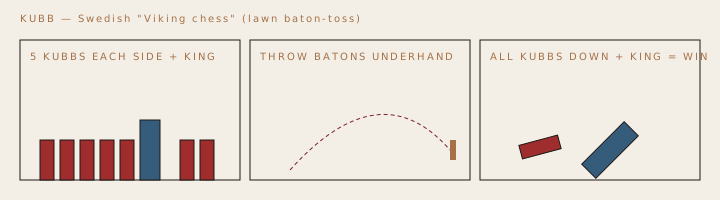
A grass meadow on the island of Gotland, midsommar afternoon, the long Swedish summer light still hours from dimming. Six wooden blocks — kubb — stand in a row at the far baseline. The king — a slightly larger crowned block — stands sentry at the centre. My uncle takes a wooden throwing-stick — kastpinne — and underhand-tosses it across the field with a vertical spin. Klonk! It hits a kubb squarely and topples it. The kids around the field clap once and then resume eating their jordgubbstårta — strawberry cake.
How it was played
A kubb set is a small bag of carved hardwood pieces. The pieces:
- 10 kubbar — small rectangular wooden blocks, about 7 cm tall, 7 cm square at the base. Five for each team.
- 6 kastpinnar — the throwing sticks, round wooden batons about 30 cm long, 5 cm in diameter, also wooden.
- 1 king — a larger crowned block, about 12 cm tall, decorative, placed in the centre of the field.
- 4 corner stakes — small pegs marking the corners of the playing field.
The field is a rectangle, traditionally about 5 metres wide by 8 metres long, marked at the corners. Each team's baseline runs across the short edge. The king stands at the geometric centre. Each team places their five kubbar in a row along their own baseline.
Two teams play. Each team has 1, 2, or 3 players (singles, doubles, triples).
Phase 1 — Knock down the baseline. The starting team takes the six kastpinnar and throws them, underhand and with a vertical end-over-end spin (no horizontal helicopter-spin allowed — penalty for sidearm throws), at the opposing team's baseline kubbar. Throws must be made from behind the throwing team's own baseline.
Each kubb knocked over is set aside. After the first team has thrown all six kastpinnar, the other team picks up any of their kubbar that were knocked over (the field kubbar) and throws them onto the throwing team's side of the field — these become field kubbar that must be hit before the baseline kubbar in the next round.
The second team now throws all six kastpinnar. They must first knock down all the field kubbar (which are positioned roughly where the throwing team threw them), and only after all field kubbar are felled may they target the original baseline kubbar.
Throws alternate teams. Each round the team that threw kubbar onto the field has the advantage of forcing the opponent to neutralise field kubbar before the original baseline can be attacked.
Phase 2 — Knock down the king. Once a team has knocked down all the opposing team's kubbar (both field and baseline), they may attempt to knock over the king. Hitting the king means winning the game. Hitting the king prematurely — before all opposing kubbar are felled — is an instant loss.
This is the cruel symmetry of kubb: rushing the king leads to defeat. The whole game is a slow grind through the forest of kubbar before the killing blow.
The throwing technique is precise. The kastpinne must be thrown vertically — end-over-end spin — never horizontally as a helicopter. The throw is underhand. The wrist snap matters; the spin matters; the trajectory is a low arc, peaking at maybe 2-3 metres above ground, landing just past the kubb you are aiming at. A skilled thrower can knock down a single kubb at 8 metres reliably.
The setting is summer-Scandinavian. Midsommar (mid-June, the longest day of the year) is the canonical kubb day; every Swedish family has at least one kubb set in a backyard shed, and it comes out for midsommar picnics. Other settings: Saturday family barbecues, Norwegian hyttetur (cabin trips), Finnish lakeside summer-houses, Danish coastal weekends. The grass is the surface; bare feet are common; jordgubbstårta is on the picnic table.
The pace is leisurely. A kubb match runs forty minutes to an hour. Between throws there is conversation, beer, the slow Scandinavian summer light that doesn't really set until 10 or 11 pm. The game is the structure that holds the picnic together.
Variants. The standard kubb described above is the codified version, formalised in the 1990s by Swedish kubb tournaments and the VM i Kubb — World Kubb Championship — held annually on Gotland since 1995. Some regional variants use slightly different field sizes (Norwegian kubb tends to play on a slightly larger field), different throwing rules (some Finnish variants permit one warm-up throw per team per round), or different scoring conventions. The German-American Vikingschach variant is essentially the same game with slightly more codified field marking.
What it meant
Kubb is, in its modern form, a relatively recent revival. Wooden block-throwing games of various forms existed in Scandinavian rural culture for centuries — Viking-era references to klubba and similar block games appear in old sagas — but the modern codified kubb with the specific 10-kubb-and-king configuration was assembled in the 1980s on the island of Gotland, drawing on older folk-game traditions and codifying them into a tournament-rated sport. The "Viking Chess" branding (Vikingaschack) is partly authentic — the game has Old Norse roots — and partly marketing — the modern codification is recent.
The game has had a remarkable global spread. Since the 1990s, kubb tournaments have appeared in the United States (especially Minnesota and Wisconsin, with their large Scandinavian-diaspora populations — the Kubb Madison Cup in Wisconsin is one of the largest in North America), in Germany, in the UK, and across Australia and New Zealand. The game travels well because it is portable (a small wooden bag fits in a backpack), durable (hardwood blocks last forever), and accessible (rules are learnable in five minutes).
It taught — teaches — patience, target acquisition, and team-coordination. In doubles or triples play, teammates have to coordinate which player throws at which kubb, and the rotation of who throws first in each round is itself strategic. Rushing the king prematurely loses the game; the lesson is patience.
It also taught the Scandinavian summer ritual. Kubb on midsommar afternoon is one of the iconic images of Swedish family life, alongside strawberry cake, flower crowns, and the slow ten-pm sun. The game is the structural framework for the midsommar gathering. Without it, midsommar lacks one of its scaffolds.
The cousin games are the wider Scandinavian outdoor-throwing tradition — Finnish Mölkky (a numbered wooden-pin game with similar throwing mechanics, also a global export), Danish Bunker, and more distantly the Italian Lippa and the Polish Klipa. The fundamental block-throwing-at-target idea is widely distributed across Northern Europe.
What is lost when kubb declines: the lawn. Modern Swedish urban families have less grassy backyard space than the rural ones did. The midsommar picnic still happens but is increasingly held in public parks rather than private gardens, and kubb requires a clear 5×8 metre rectangle that not every park accommodates. The game is robust globally but slightly thinner in the cities of its homeland.
How we'll bring it online
Top-down 3D field view with grass texture (selectable as Gotland meadow, Norwegian forest-clearing, Wisconsin park, Australian backyard). The kubbar stand at their baselines and field positions; the king sentinels the centre. The throw is a vertical-flick gesture: drag the kastpinne in the direction and force of intended throw, with on-screen indicators for arc and end-over-end spin verification.
Live two-player (singles), four-player (doubles), or six-player (triples) matches over voice. The voice room makes the game; kubb is naturally a slow, conversational game with extended pauses between throws.
Async mode: each throw is a turn, pushed to the opponent. Excellent for slow-paced kubb where a single match might span a working week, with each player throwing one kastpinne a day during a coffee-break. The pace works.
The sidearm-helicopter detection is enforced — we model the throw motion and detect whether the player is using the legal vertical-spin or attempting the prohibited horizontal-spin. Helicopter throws are flagged and treated as fouls, just as in tournament play.
Cosmetic layer: kubb wood designs (classic Gotland birch, Norwegian pine, American maple, Australian eucalyptus), king-crown styles (classical Swedish, Viking-era replica, modern minimalist), kastpinne grain patterns, field surfaces (Gotland meadow grass, Norwegian forest moss, Wisconsin park clipped lawn, Tasmanian sea-grass, urban park artificial turf). Voice-pack: the midsommar ambient — flower-crown rustle, distant abba on a portable speaker, Scandinavian summer afternoon quiet, regional Swedish/Norwegian/Finnish accent commentary.
What doesn't translate: the jordgubbstårta. The midsummer cake at the picnic table next to the kubb field. The flower crowns. The 10pm sun that doesn't really set. Kubb is the game; midsommar is the atmosphere; the second is harder to render than the first.
Voices
(Pending. Voice memos to be recorded with native speakers from Gotland / Stockholm / Oslo / Madison Wisconsin by Phase 1.)


