Tavla
The dice rattle in the leather zar zar cup once, twice, and clatter onto the wooden board with a sharp crack. The Istanbul çay bahçesi — tea garden — has six other tables exactly like this one, each with two old men hunched over a board, each with a glass of black tea cooling in a tulip cup beside the elbow. "Şeş Beş!" my grandfather calls — six and five — and slides his pieces with the practiced flick of someone who has done this for sixty years.
How it was played
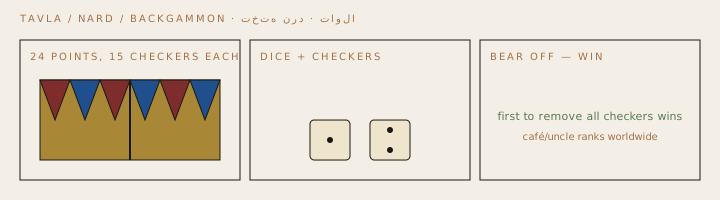
A tavla board is a long rectangular tray, hinged at the centre so it folds shut into a portable case. The interior is split into four quadrants by a raised central bar. Each quadrant has six narrow triangular points — house points — alternating in colour. There are 24 points total. Each player has 15 checkers — pul — and starts with a fixed setup: two on the opponent's far point, five on the opponent's mid-quadrant point, three on a nearby quadrant point, and five on the near home point.
The aim is simple: race all 15 of your pul around the board (in one direction for you, the opposite for your opponent), into your home quadrant, and then off the board. First to bear off all 15 wins.
You roll two dice on each turn. The numbers you roll are the move-distances available — you can move one pul by the sum of both dice, or two different puls by each die separately. Doubles let you play four moves of that number.
But you cannot move freely. A point is blocked if the opponent has two or more pul sitting on it. You cannot land on a blocked point. If you land on a point with a single opponent pul — a blot — you hit it, sending the opponent's checker to the bar (the central raised divider), from which it must re-enter the board through your home quadrant on the next roll. Re-entering against a stack of blocked points is brutal; whole games turn on a single missed re-entry.
The Turkish tavla has its own dialect of dice-roll names, all in Persian-derived numerical Turkish: yek (1), dü (2), se (3), cihar (4), penç (5), şeş (6). Combinations: Şeş Beş (6-5), Düşeş (double 6, the strongest possible roll), Hep yek (double 1, miserable), Cihar-i Cihar (double 4). The names are spoken aloud as the dice land — partly tradition, partly a way for kibitzers around the table to follow the game.
There are three Turkish variants of the game commonly played: Tavla (standard backgammon, the version above), Mahbusa (where a single pul on a point is "imprisoned" — opponent stacks on top of it and the pul cannot move until released), and Gül Bara (where each side starts on a single point and races through). A typical çay bahçesi afternoon plays a best-of-five rotating through all three.
The pieces are checkers — round flat discs, traditionally wood, now often plastic. The board is leather-faced or felt-faced or polished hardwood. The dice are small bone or plastic cubes, six-sided. The dice cup is leather or felt-lined, and the Istanbul tradition is to zar zar — rattle the cup vigorously — before each roll, partly for randomness, partly for the dramatic sound. A roll without a zar zar is considered slightly suspect.
The pace is leisurely. Turkish tavla is not a speed game. Between moves the players sip tea, light cigarettes, comment on a passing dog, debate the latest match between Galatasaray and Fenerbahçe. A best-of-five could take three hours and feel short. The çay bahçesi depends on this — the tea is sold by the cup, the cup is refilled three times an afternoon, the proprietor needs you to stay.
Variants by region: in Istanbul the standard rules are tight and competitive. In Ankara Mahbusa dominates. On the Black Sea coast the rolls of doubles are sometimes scored at quadruple value rather than double. In Cyprus (both halves of the island) the game is identical but the dice-call cadence is slightly different. In the Turkish-speaking diaspora — Berlin's Kreuzberg, Rotterdam, Stockholm — the boards have travelled with the families and the rules have ossified at the version of the year of emigration.
What it meant
Tavla is the social game of the Turkish coffeehouse. From the late Ottoman period through to the present, in any city or village in Anatolia or beyond, the place where men gathered in the late afternoon to talk politics, complain about prices, and maintain their friendships, was the kahvehane or çay bahçesi — and the tavla board was on the table. The game gave a structure to the conversation; men who did not have anything urgent to say to each other could still spend two hours together because the board demanded their attention in pulses.
It is, of course, the same game as Western Backgammon — and ultimately the same game as the Persian Nard, the Greek Tavli, the Egyptian and Levantine variants of Sheshbesh, the Roman Tabula. The earliest archaeological evidence of the game family is from the Royal Game of Ur (Mesopotamia, 2600 BCE) and the Persian Nard (6th century CE). Tavla in modern Turkish is an inheritor of the ancient Persian Nard with a thousand years of Anatolian and Ottoman variation. The dice-roll names — yek, dü, se, cihar, penç, şeş — are the original Persian numerals, preserved in Turkish only in this game, like a fossil of a deeper history.
Cousin games run in every direction: Greek Tavli (essentially the same three variants), Egyptian Tawla, Lebanese and Syrian Shesh-besh, Iraqi Sheş Beş, Iranian Nard, all the way to Western Backgammon as standardised in the 19th century by British clubs.
It taught probability — though never explicitly. A child who plays tavla with his father for three years has a working intuition for the distribution of dice rolls without ever calculating it.
What is lost when tavla declines: the coffeehouse itself. Modern Turkish cafés are franchised chains — Starbucks, Kahve Dünyası — which do not encourage three-hour board games. The traditional kahvehane still exists but the average age of its patrons keeps climbing. The young men play tavla mostly online now, and they play faster and shorter games, and they do not stay for the cigarettes and the politics.
How we'll bring it online
3D wooden board with realistic dice physics. The dice cup is rattle-and-toss — shake the phone, see the dice tumble, watch them land. The pul movement is touch-and-drag with a satisfying thunk on placement and an automatic-move helper that highlights legal landing points (toggleable for purists who want to read the board cold).
Live two-player matches over voice. The voice room is essential — tavla without commentary is just abstract calculation. We support hot-seat (two players, one phone) for the original çay bahçesi feel. Async mode: each turn is a roll-and-move, pushed to the opponent. Excellent for a long-distance grandfather-grandson rhythm.
We support all three Turkish variants — Tavla, Mahbusa, Gül Bara — selectable at table creation, and a tournament rotation that plays best-of-five across all three.
Cosmetic layer: board materials (Istanbul leather-faced, Anatolian walnut, mother-of-pearl-inlaid Ottoman style, modern minimalist), pul materials (wood, bone, mother-of-pearl, plastic), dice variants (bone, polished wood, ivory-white, vintage Bakelite), tea-cup ambient (tulip-glass black tea visible at the corner of the screen). Voice-pack with the dice-call cadence in classical Turkish-Persian numerals, and in Ottoman, in Cypriot Turkish, and the standard Istanbul kahvehane dialect.
What doesn't translate: the smoke. The blue cigarette haze in a 1970s Istanbul coffeehouse, the smell of the çay simmering on the brass semaver — these are part of the game in a way no phone app can capture.
Voices
(Pending. Voice memos to be recorded with native speakers from Istanbul / Ankara / Berlin Kreuzberg / Nicosia by Phase 1.)


