Four Square
The yellow-painted blacktop behind the elementary school in suburban New Jersey, the four squares chalked permanently into the asphalt by the gym teacher every September. A red rubber playground ball — the kind that smelled faintly like a tire — and a line of fourth-graders waiting for their turn to enter. The kid in King square serves with a slap-bounce, and the ball arcs across to my square, and I have one bounce to return it before I'm out and trudging back to the end of the line.
How it was played
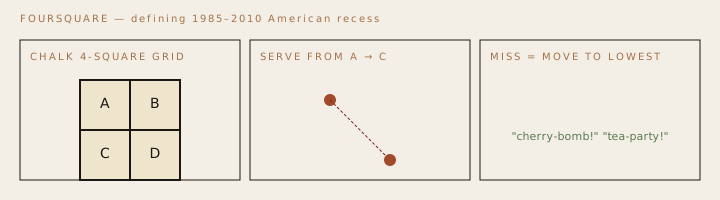
A flat outdoor surface — blacktop, tile, concrete, gym floor — is divided into four squares of equal size, arranged in a 2×2 pattern, painted or chalked permanently. The squares are labelled by rank: King (sometimes Ace), Queen, Jack, Joker (sometimes Dunce). The squares are large enough to accommodate one player standing comfortably — about eight feet on each side in school-yard standard.
Four players occupy the four squares, one each. The remaining kids wait in a line at the Joker corner.
A red rubber playground ball — hollow, slightly soft, about ten inches in diameter — is the equipment. The King serves: bounces the ball once in their own square, then slap-hits it across the dividing line into another square. The receiving player has one bounce in their own square to return the ball — slap it into another square — and play continues. If you fail to return cleanly, you are out.
What counts as failing varies but typically:
- Letting the ball bounce twice in your square — out.
- Hitting the ball but it lands outside the four-square area — out.
- Hitting the ball and it bounces in your own square instead of someone else's — out.
- Hitting the ball with a closed fist or two hands (in most rule-sets) — out.
- Holding the ball or carrying it — out.
When you are out, you leave your square and walk to the end of the line at the Joker corner. Every other player rotates up one rank: if Queen got out, Jack moves to Queen's square, Joker moves to Jack's, and the front of the line moves into Joker. The remaining squares stay where they are. The aim is to reach King and stay there as long as possible.
The King has special privilege in most rule-sets. The King calls the rules at the start of their reign. "Cherry bomb!" — the King is allowed to slap the ball especially hard on the serve. "Around the world" — the ball must rotate squares in a specific order. "No bus stops" — you cannot slap the ball back to the player who just slapped it to you. The list of rule-modifiers — the kingdom rules — is a folk tradition that varies by school, by year, and sometimes by recess.
A typical American school-yard Four Square recess has fifteen kids in the line and four in the squares, with a constant rotation that means each kid plays one to three returns before being knocked out and walking back to the line. The pace is fast. A player can be in and out of the squares three times in a single ten-minute recess.
There is a fierce schoolyard culture around the cherry bomb and other power slaps. Some kids are notorious bomb-callers — the King who, every time he gets to the throne, calls cherry bomb and slams the ball so hard that the next player has half a second to react. Other kids are defenders — the Queen who stays alive in Queen's square through ten consecutive turnovers. The folklore is real and is replayed every September when school starts.
Variants. American school-yard standard (above) is the most widespread. Gaga is a related game in a hexagonal pit, with no squares but the same rotation logic. Skyball — a regional variant in the Pacific Northwest — uses a smaller, harder ball and allows volley returns above shoulder height. The British Wallball is a distant cousin (single wall, single ball, multiple players) and Australian Foursquare uses the same chalked squares but with a tennis ball and one-bounce-only rules.
What it meant
Four Square is, more than any other game, the shared foundational game of the American childhood. Its physical infrastructure — the four chalked squares — sits on the blacktop of nearly every elementary school in the United States and Canada, repainted by maintenance every summer. Generations of American children have learned it without anyone teaching them; you just see it and join the line.
It taught the school-yard's first lessons in order and rotation. Everyone gets a turn. The line moves. The King's reign is temporary. The kid who is bad at it today might be in Queen's square next week. The democracy of the line is an early form of civic education, encoded in red rubber and chalk.
It also taught the kingdom rule — the recognition that whoever holds power can change the rules within limits, that the rules are not fixed but negotiated, that calling cherry bomb is legal but calling electrocution (whatever that meant in your particular school) was a step too far and would be vetoed by the line. American school-yard Four Square is a low-stakes lesson in constitutional negotiation.
The cousin games span the world. South Asian Sat-Stone (similar rotation logic in some variants), British Wallball, Australian Foursquare, the Israeli Shesh-Mishesh. The fundamental idea — multiple players, ranked spaces, rotation by elimination — is broadly distributed; the American chalked-square version is uniquely embedded in the public-school built environment.
What is lost when Four Square fades — and it has not faded, it remains one of the most-played American school-yard games — would be the recess. Modern American schools are reducing recess time, and the chalked squares are sometimes painted over or replaced with structured play areas. Four Square survives in the schools that protect the unstructured recess, and it dies in the schools that don't.
How we'll bring it online
Top-down 3D blacktop with the four chalked squares. Players occupy the four squares from a top-isometric angle. The ball is rendered with realistic playground-ball physics (hollow rubber, slight squish on contact). The slap is a swipe gesture — drag the ball in the direction of intended target square, with calibrated power and angle.
Live four-player matches with a queue of waiting players (up to 12 in queue). The rotation is automatic: when you go out, you rotate to the back of the queue, and the front of the queue rotates into the empty Joker square. We replicate the chained rotation precisely.
Voice-room mandatory — the trash-talk and the kingdom rule calls are essential to Four Square. The King has a UI to call the round's special rule (cherry bomb, no bus stops, etc.) before each serve. Async mode is impossible for this game — Four Square is purely live.
Cosmetic layer: blacktop surfaces (suburban NJ school, urban Brooklyn schoolyard, California playground, Toronto winter-tile gym), ball designs (classic red rubber, vintage 1980s rougher-textured, neon modern, gym-floor indoor variant), King-crown overlays, chalk-style variations. Voice-pack: school-bell ambient, the gym teacher whistling, kid-voice line packs in five regional American English accents.
What doesn't translate: the line. The kids waiting at the corner, watching, calling out "Joker, you out!", learning the rules by witnessing. We render a queue but it is not the same as twelve fourth-graders shoving each other in a polite half-line on the asphalt.
Voices
(Pending. Voice memos to be recorded with native speakers from New Jersey / California / Texas / Ontario by Phase 1.)


