Morabaraba
A board scratched into the dust outside the kraal — three concentric squares connected by lines, twenty-four points where a piece could sit. My grandfather and his cousin, both in their seventies, both wearing the long Sotho blanket against the highveld evening cold, hunched on small wooden stools across a stone-table. He places a cow — kgomo, a small carved wood-piece — on the line. "Eish," his cousin breathes. The placement has set up a mill, three cows in a row, and a capture is coming.
How it was played
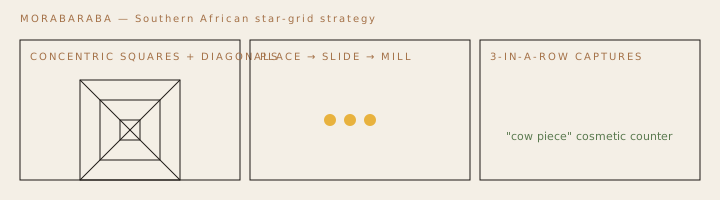
A Morabaraba board has 24 points arranged as three concentric squares connected by four lines through the middles. The points are at the corners of each square (8 total) and at the midpoints of each side (8 total), with eight more at the connecting lines' intersections (well — actually, the midpoint-to-midpoint connecting lines are common in some variants, less in others; the standard South African Morabaraba uses the classical Twelve-Men's-Morris layout).
Each player has 12 kgomo — cows — represented as small carved wood, smooth pebbles, beans, or in modern sets, plastic counters. Traditionally one player's cows are dark, the other's light.
The game has three phases:
Phase 1 — Placing. Players take turns placing one cow at a time onto any empty point. The aim is to form a molomo (a mill) — three of your cows in a row along one of the board's lines. When you form a mill, you remove one of your opponent's cows from the board (the captured cow is permanently out of play). You cannot remove a cow that is part of an opponent's existing mill, unless every one of the opponent's cows is already in a mill.
Phase 2 — Moving. Once both players have placed all 12 of their cows, they begin moving. On each turn, you slide one of your cows along a line to an adjacent empty point. Forming a new mill — or "breaking and remaking" an existing mill by moving a cow out and back in on a subsequent turn — captures another opponent's cow.
Phase 3 — Flying. When a player is reduced to 3 cows, that player enters the flying phase: their cows can move from any point to any other empty point, not just adjacent ones. This often allows desperate counter-attacks. The game ends when either player is reduced to 2 cows (loses) or has no legal moves (loses).
The strategic richness comes from the mill mechanic. A skilled player sets up swing mills — a configuration where moving a cow back and forth between two positions remakes a mill on every other turn, capturing an opponent's cow each time. Two cooperating swing mills can capture three opponent cows in five moves. Recognising and preventing swing-mill setups is the heart of Morabaraba strategy.
The board is improvised everywhere. Drawn in dust outside a Lesotho rondavel. Scratched onto a stone tabletop in a Soweto courtyard. Painted on the back of a folding kgokong card. Carved into the wood of a Botswanan elder's snuff-box (yes — there are pocket Morabaraba boards small enough to fit on a snuff-box lid). The cows are improvised too: in a refugee camp, bottle caps. In the rural Free State, dried beans. In the urban township, plastic checkers from a department-store Snakes-and-Ladders set.
The pace of play is contemplative. A serious match between elders runs forty minutes to an hour, sometimes longer. The kraal — the cattle enclosure — is the traditional setting; the men herding cattle would carve a board into the dust as they waited for the cattle to settle, and play through the evening while watching the herd. The game is intimately connected with cattle-keeping in the Sotho-Tswana cultural imagination — the kgomo (cow) game played while watching real kgomo (cows).
Variants. Morabaraba is the standard South African and Lesotho name; Mlabalaba is the Zulu name; Tsoro Yemutatu is the Shona Zimbabwean cousin (with slightly different board geometry). The English-language Twelve Men's Morris is the same game, traceable to medieval Europe and beyond — the world's oldest known board with this design was found in an ancient Egyptian temple roof, scratched by bored Roman-era workmen. The South African version preserves the rules with high fidelity.
Morabaraba is recognised by Mind Sports South Africa as a competitive sport, with annual national championships. There are professional rated Morabaraba players in South Africa. The 2003 South African champion competed in the World Mind Sports Games. The game has, in the post-apartheid period, been deliberately revived as a marker of pre-colonial African intellectual heritage — taught in some primary-school curricula, played on Heritage Day.
What it meant
Morabaraba is older than most of the cultures that play it — by some accounts, the place-and-mill family of games is among the oldest abstract strategy games in human history. The 24-point three-square board has been found scratched into temple roofs in Kurna (Egypt), Roman taverns in Britain (where it became Nine Men's Morris), and medieval European cathedral cloisters (where monks played to pass the watch). The Southern African version is Twelve Men's — the more elaborate twelve-piece variant, which most game historians now believe diffused through Bantu migrations from East Africa or arrived via Arab-Indian Ocean trade contact.
In the Sotho-Tswana cultural context, Morabaraba was not casual amusement. It was the elder's game — the way grandfathers thought through problems. Disputes between cousins, decisions about which field to plant, recommendations for who should marry whom — all could be deferred while a Morabaraba match was played, the assumption being that the slow strategic thinking the game required was the same thinking required for the human decision. The board was a thinking surface.
It taught patience and pattern recognition. A child watching a grandfather's Morabaraba match learned, by osmosis, to see three-in-a-row patterns, to anticipate two and three moves ahead, to recognise the swing-mill threat before it materialised. The same cognitive shape transferred to school mathematics — and, in fact, post-apartheid education research in South Africa has found measurable correlations between primary-school exposure to Morabaraba and downstream geometric reasoning skill.
The cousin games are global — Nine Men's Morris, the European Mühle, the Roman Ludus Latrunculorum (closely related), the Indian Navakankari (the same nine-piece structure imported via colonial routes). Morabaraba is the most preserved African instance and the most rule-rich variant.
What is lost when Morabaraba declines: the elders' afternoon. The slow shape of decision-making by board. The transmission of patient strategic thinking across generations. The Heritage-Day revival has slowed the decline but the game is still thinner in urban townships than in the rural kraals.
How we'll bring it online
3D board view with the three-concentric-squares geometry. Players see the points as small dimples on a dust-textured or wood-textured surface. Cows are placed by tap; moves are drag-and-snap to legal adjacent points. Mills are highlighted automatically; captures animate with a clean removal of the opponent's cow.
Live two-player matches over voice. Async mode is excellent for Morabaraba — a turn a day fits the contemplative pace. The game also lends itself to teaching: we built a tutorial that walks through opening phases, mill formation, swing-mill defence, and the flying-phase endgame.
Cosmetic layer: board surfaces (red highveld dust, dark Lesotho-stone, Sotho woven blanket pattern, modern lacquered hardwood), cow-piece designs (carved wood kgomo, smooth pebble, dried beans, brass-cast figures), settings (rondavel courtyard sunset, Soweto stone-table, Botswanan kgotla afternoon, Zimbabwean dare). Voice-pack: the highveld evening ambient — distant cattle low, the isiZulu cousin commentary, the Sotho elder's quiet eish of recognition.
We support competitive ranked play with an Elo-style rating; Morabaraba is a true strategic sport, and we treat it like one. Tournament mode runs on monthly cycles, with regional brackets for South Africa, Lesotho, Botswana, Zimbabwe, and a global open bracket.
What doesn't translate: the kraal. The smell of cattle, the cool of the highveld evening air, the sound of cattle settling for the night while elders play in the firelight. We can recreate the visual; the bodily presence of the herd is part of the game's traditional context.
Voices
(Pending. Voice memos to be recorded with native speakers from Maseru / Soweto / Gaborone / Bulawayo by Phase 1.)


